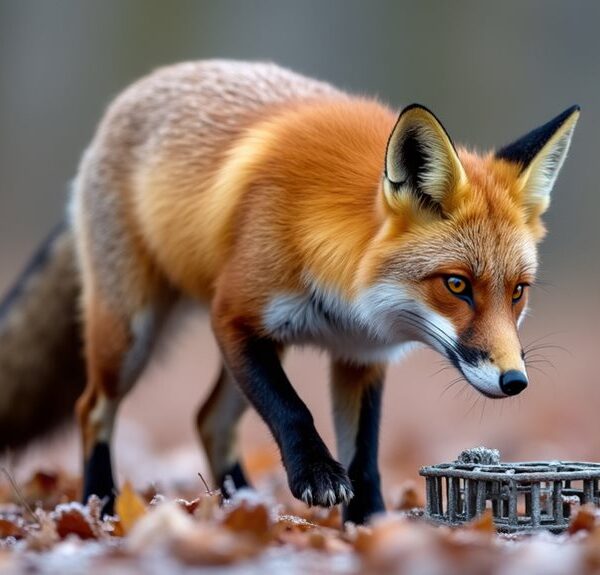

Foxes aren’t just beautiful—they’re nature’s master tricksters. You’ll find them using clever hunting techniques like the snow plunge, where they listen for prey beneath snow before making a precise leap. They’ve evolved remarkable camouflage abilities, changing coat colors seasonally to blend with their surroundings. When protecting their young, they’ll even fake injuries to lure predators away from their dens. Their cunning extends to urban areas too, where they’ve adapted to human environments with surprising ingenuity.
The Evolution of Fox Intelligence

While most people know foxes as clever tricksters from fables and folklore, the true story of their intelligence is even more fascinating. These adaptable creatures have developed remarkable cognitive abilities through thousands of years of evolution in diverse habitats.
You’ll be amazed to learn that a fox’s brain has evolved to solve complex problems that guarantee their survival. They can remember food cache locations, anticipate prey movements, and even use clever hunting strategies that suggest advanced reasoning.
Their intelligence isn’t just about finding food, though. It’s deeply connected to their social dynamics. Fox families communicate through an impressive range of vocalizations and body language, creating sophisticated interactions within their communities. They’re constantly learning, adapting, and teaching their young the skills needed to thrive in ever-changing environments, showcasing their remarkable ability to utilize vocalizations to convey important messages effectively.

Perfect Fit: Specially designed to fit our exclusive large 23” white goose statue (sold separately), this costume ensures your lawn goose looks its best in any weather.

Charming illustrated fox in a classic tweed blazer and scarf, capturing a sophisticated autumn garden party mood with warm seasonal tones and whimsical woodland character art.

Masters of Disguise: Fox Camouflage Techniques
You’ll be amazed at how foxes transform their coats with the changing seasons, shifting from reddish-brown in summer to thicker, grayish fur in winter.
When you’re walking through the woods, you might completely miss a fox resting on the forest floor, as their fur perfectly mimics the dappled sunlight and fallen leaves around them.
Their natural camouflage isn’t just beautiful—it’s a survival strategy that’s evolved over thousands of years, allowing these clever creatures to hide from both predators and prey. This clever adaptation, combined with their seasonal fur color change, enhances their effectiveness in evading detection in their environment.
Seasonal Coat Changes
As temperatures drop and scenery change, foxes undergo remarkable seasonal changes to their coats—nature’s way of providing these cunning creatures with year-round protection.
You’ll notice these seasonal adaptations most dramatically in species like the Arctic fox, which shifts from brown-gray summer fur to pristine white winter coats as days grow shorter.
This impressive fur coloration isn’t just for show! The fox’s body responds to changing daylight hours, triggering hormonal shifts that alter pigment production.
When you’re watching a fox in autumn, you’re witnessing this gradual shift as they prepare for winter’s challenges. Their winter coats grow approximately 30% thicker, with added insulation that traps warm air close to their skin.
It’s like they’re putting on a custom-designed parka, perfectly suited to their environment! Interestingly, this change in coloration also serves as a crucial camouflage for hunting, allowing them to blend seamlessly into the snowy landscape during winter months.
Forest Floor Blending
The winter coat isn’t the fox’s only survival strategy—their ability to disappear into their surroundings is equally impressive.
You’ll rarely spot these crafty creatures when they’re motionless on the forest floor, their rusty fur blending seamlessly with fallen leaves and pine needles.
This remarkable color adaptation isn’t just luck—it’s evolution at work! When you’re searching for foxes in their natural habitat, you’re actually participating in a game they’ve mastered over thousands of years.
Their fur contains special pigments that mirror the earthy tones around them, creating a natural camouflage effect. Their keen sense of smell, with its complex anatomical adaptations like nasal turbinates, also aids in their ability to navigate their environment stealthily.
Next time you’re hiking through the woods, remember that you might be passing by these clever tricksters without even knowing it.
They’re watching you, perfectly still, practically invisible among the dappled shadows and autumn colors.
Hunting Strategies: The Calculated Pounce

You’ll be amazed at how foxes hunt with calculated precision, combining patient waiting with their remarkable ability to track prey through sound alone.
When hunting in snowy terrain, they’ll cock their heads to pinpoint a mouse or vole moving beneath the snow, then launch into their signature “snow plunge” with stunning accuracy.
Their hunting success relies on this perfect blend of patience, listening skills, and the perfectly timed pounce that’s become their trademark in the wild. Furthermore, their high rod density enhances their ability to detect movement and hunt effectively in low-light conditions.
Calculated Snow Plunge
When winter blankets the terrain in thick snow, red foxes deploy their most spectacular hunting technique—the calculated snow plunge.
You’ll witness these clever hunters tilting their heads from side to side, listening intently for the faint rustling of rodents beneath the snow’s surface. With ears perfectly triangulated on their prey, they’ll suddenly leap upward and dive headfirst into the powder—a breathtaking display of snow diving that often leaves onlookers amazed.
This remarkable ability isn’t just for show; it’s vital for winter survival when food becomes scarce. Their front paws act as precise tools, digging rapidly to secure their meal once they’ve made contact.
What’s truly impressive is their success rate—they’ll catch their target nearly 75% of the time! Nature’s precision hunters don’t just survive winter; they master it. Keen senses of smell and hearing allow them to detect food hidden beneath the snow, further enhancing their hunting prowess.
Tracking Through Sound
Few hunting strategies in the animal kingdom demonstrate such precise calculation as a fox’s auditory tracking system.
You’ll be amazed at how these clever creatures use sonic navigation to pinpoint prey hiding beneath snow or dense vegetation. Their specialized ears can detect the faintest sounds, from a mouse’s heartbeat to the rustle of a vole under leaves.
- Their ears rotate independently, creating a three-dimensional sonic map
- They can hear rodents moving up to 40 yards away, even under 3 feet of snow
- A fox’s brain processes auditory cues in milliseconds, calculating exact jumping angles
- They’ll tilt their heads at different angles to triangulate precise prey locations
When you’re watching a fox hunt, you’re witnessing nature’s perfect example of auditory precision in action—a remarkable blend of instinct and mathematical precision. Moreover, these strategic hunters rely on their vocalizations during territory defense to communicate with other foxes and establish their hunting grounds.
Patience and Precision
The fox’s calculated pounce represents one of nature’s most impressive displays of patience and precision. You’d be amazed watching these clever hunters in action—they combine stealthy movements with remarkable focus to secure their next meal.
When a fox hunts, it’s not merely randomly chasing prey. There’s genuine strategic planning happening in that crafty mind! They’ll freeze completely still for minutes, ears forward, muscles tensed but ready. You can almost see the calculations happening behind those bright eyes.
What makes foxes truly remarkable is how they adjust their technique based on terrain and prey type. Sometimes they’ll stalk slowly, other times they’ll use quick, zigzagging patterns to confuse their target.
Their signature move—the high, arching leap followed by a pinpoint landing—shows just how brilliantly evolution has shaped these woodland hunters. In addition to their hunting prowess, red foxes also have an adaptable diet that includes seasonal variations in their food sources like berries and small mammals.
Deceptive Behaviors to Protect Their Young

Since foxes are instinctively protective parents, they’ve developed remarkably deceptive tactics to keep their vulnerable young safe from predators.
Nature’s master illusionists, foxes employ cunning deception to shield their precious kits from harm’s way.
You’ll notice their maternal instincts kick in strongly when kits are born, transforming these normally solitary animals into fiercely protective guardians.
When you observe foxes in the wild, you might witness these clever protective behaviors:
- The “injured prey” act – limping away from the den to draw predators toward themselves
- Multiple den entrances – creating confusion about where their kits are hidden
- Carrying their young to new locations when they sense danger
- Marking false trails with their scent to mislead potential threats
Additionally, these tactics exemplify the influence of social dynamics on fox behavior, specifically in how they prioritize the protection of their young.
You’d be amazed how these intelligent creatures balance hunting with safeguarding their offspring, often sacrificing their own safety to guarantee their family’s survival.
Urban Adaptation: Foxes in Human Landscapes
Urban scavenging has become second nature to foxes. They’ll rummage through your trash bins, snack on fallen fruit in your garden, and even feast on the kibble you’ve left out for your pets. When it comes to suburban denning, these resourceful animals transform forgotten spaces beneath decks and garden sheds into cozy homes for their kits. Unlike their rural cousins, city foxes have grown bolder around humans while maintaining their natural wariness—a delicate balance that’s helped them thrive where many wildlife species struggle. Their ability to establish territory reflects the balance between food supply access and safe denning.
Communication and Social Trickery Among Fox Species

Beyond their adaptability to human environments, foxes communicate with astonishing complexity that you’d never guess from their seemingly solitary nature.
They’ve developed sophisticated vocal communication systems that help maintain their social hierarchy in the wild.
When you’re near a fox habitat, you might hear their repertoire of sounds:
- Yips and barks that signal territorial boundaries to neighboring fox families
- High-pitched whines used between mates during breeding season
- Sharp alarm calls that warn others of approaching predators
- Gentle murmuring sounds parents use when interacting with their kits
You’ll notice foxes aren’t truly loners—they’re actually quite social within their family groups.
They’ll use body language alongside vocalizations, with tail positions and ear movements conveying important messages that help them maneuver their complex relationships.
Legendary Status: Foxes in Global Mythology
These sophisticated communication systems have earned foxes a special place not just in nature, but in human storytelling across the world.
You’ll find foxes woven into the fabric of countless cultures, where their mythical symbolism often reflects their real-life cunning.
In Japanese folklore, you’ve probably heard of kitsune, fox spirits with magical abilities who can transform into human form. These tricksters aren’t always villains – they’re complex characters who might reward kindness or punish arrogance.
Native American traditions celebrate the fox as both a wise creator and a mischievous trickster, while European tales often cast them as clever heroes outsmarting stronger opponents.
These cultural representations show how deeply we’ve been fascinated by these animals throughout history. Their intelligence and adaptability have made them perfect vessels for our human stories about wisdom, trickery, and survival.
Conservation Challenges for Nature’s Clever Canids

Despite their legendary adaptability, foxes face growing threats in our rapidly changing world.
You’ve probably noticed fewer foxes in areas where they once thrived, as human development continues to encroach on their territories. Habitat preservation remains essential for maintaining genetic diversity among fox populations.
When you support conservation efforts, you’re helping these resourceful creatures survive against mounting odds.
- Urban expansion fragments fox territories, forcing them into dangerous human interactions
- Climate change alters traditional hunting grounds and food availability
- Road networks increase mortality rates through vehicle collisions
- Fur trade and pest control practices continue to target fox populations
You can make a difference by advocating for wildlife corridors and supporting organizations dedicated to protecting these intelligent canids before it’s too late.
Final Thoughts
You’ve now glimpsed the remarkable world of foxes, where cunning isn’t just a trait but a survival masterpiece. From their calculated hunting pounces to their urban adaptability, these tricksters have outsmarted both predators and time itself. As silent as shadows yet bright as flame, foxes remind us that intelligence comes in many forms. Their story isn’t just about survival—it’s about thriving through wit in a world that never stops challenging them.