
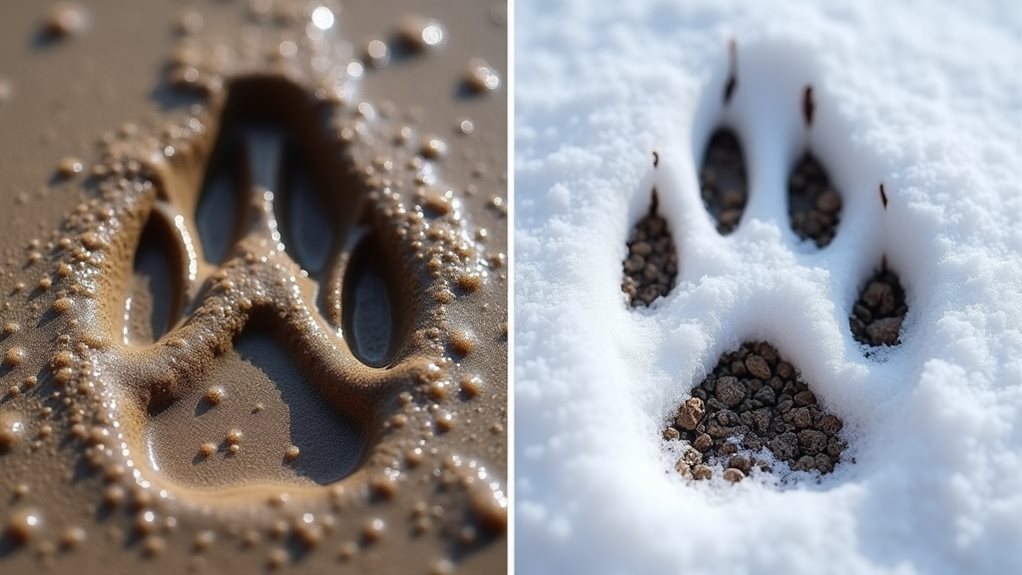
Fox tracks measure about 2 inches long by 1.5 inches wide with an oval shape and distinctive X pattern between pads. You’ll notice four toe pads with the two middle toes sitting slightly forward, and tiny claw marks that dogs lack. Unlike coyotes, fox prints are smaller and more diamond-shaped. They typically travel in straight lines when hunting, especially in winter. The subtle details in their tracks reveal fascinating stories about their behavior and habits.
Fox Track Basics: Size, Shape and Key Features

Footprints in the snow or mud can tell fascinating stories about the wildlife in your area. When you’re exploring a fox habitat, look for distinctive tracks measuring about 2 inches long by 1.5 inches wide.
Unlike dog prints, fox tracks are more oval-shaped with a prominent central pad and four toe pads arranged in an almost perfect X pattern. You’ll notice less space between pads than in coyote tracks, and fox prints often show clear claw marks.
Fox tracks reveal their identity through oval shape, X-pattern toe pads, and distinctive claw marks—nature’s perfect signature in the wild.
Remember tracking ethics while you’re out there—avoid disturbing active den sites and always stay on established trails when possible. Observing active den sites can provide insights into their behaviors and habits.
The neat, symmetrical nature of fox prints reflects their graceful, light-footed movement through the terrain. Once you’ve spotted these telltale signs, you’re well on your way to becoming a fox-tracking expert!

A SIMPLE TOOL TO MANAGE ANXIETY & IMPROVE MENTAL HEALTH – This guided journal for mental health offers an effective and straightforward system to deal with anxiety and the events that trigger it, supporting your mental health and overall well-being.


Distinguishing Fox Prints From Dogs and Coyotes
When you’re out tracking wildlife, you’ll need to know how to tell fox prints from other similar animals like dogs and coyotes.
You can spot the difference by comparing their size and shape, with fox prints being smaller and more diamond-shaped than the rounder dog tracks and larger coyote impressions.
Pay close attention to claw mark patterns and walking gait, as foxes typically leave a straighter, more direct trail with their neat, compact paws showing less prominent claw marks than their canine cousins.
Size and Shape Differences
Distinguishing fox tracks from those of dogs and coyotes requires a keen eye for subtle size and shape differences. Fox prints are particularly smaller, typically measuring 1.5 to 2 inches in length, while coyote tracks stretch to 2.5 inches and domestic dogs show considerable size variability depending on breed.
You’ll notice that fox tracks have a more diamond-like appearance, with the two middle toes sitting slightly forward and closer together. This creates a distinctive shape characteristic that’s quite different from the rounder, more splayed dog prints.
Coyote tracks, while similar to foxes, appear more oval-shaped.
If you’re lucky enough to spot a clear print, look for the negative space between the pads—foxes typically show an “X” pattern that you won’t find in dog tracks.
Claw Mark Patterns
The shape of a print tells only part of the story—claw marks reveal the rest. When you’re examining tracks in mud or snow, pay close attention to those telltale claw impressions.
Fox prints typically show minimal claw marks compared to dogs and coyotes, thanks to their semi-retractable claws. You’ll notice fox claws appear as tiny dots just ahead of the toe pads, if visible at all.
Mastering claw mark analysis improves your tracking techniques dramatically. Dogs leave prominent, blunt claw impressions that extend well beyond the toe pads, while coyotes show moderate, sharp claw marks.
For instance, understanding the behavior and social structure of the kit fox can enhance your awareness of their tracking patterns in the wild.
If you’re uncertain, look for a pattern: consistently faint or absent claw marks across multiple prints strongly suggest you’ve found fox tracks.
Isn’t it amazing how these subtle differences help reveal the stories written in the soil?
Walking Gait Comparison
Unlike dogs that tend to wander in zigzag patterns, foxes leave remarkably straight, purposeful trails when walking. This direct path is a telltale sign when you’re trying to identify fox movement in the wild.
Through gait analysis, you’ll notice foxes have a distinctive walking style that sets them apart from their canine cousins.
- Foxes typically place their back feet in the same spots as their front feet, creating a nearly perfect overlap.
- A fox’s trail shows a more linear, direct pattern compared to a dog’s meandering path.
- Coyotes have a similar straight-line pattern but with wider spacing between prints.
- Fox prints often show a perfect 2×2 pattern when trotting.
- You’ll notice less drag marks in fox tracks as they lift their feet more cleanly.
Seasonal Variations in Fox Track Patterns
As seasons change throughout the year, fox tracks undergo fascinating transformations that you’ll want to recognize for accurate identification. During winter, you’ll notice fox prints appear more defined in snow, with clear toe and pad marks that make identification easier. Their seasonal behavior shifts too, with foxes often traveling in straighter lines to conserve energy in cold months.
Come spring and summer, tracks become less obvious as foxes adapt to habitat changes, exploring wider territories and creating more scattered patterns. Mud season presents perfect tracking opportunities, capturing detailed impressions of their paws.
You’ll spot more playful bounds and zigzags in warmer months when food is plentiful and foxes aren’t solely focused on survival. Remember, a fox’s daily routine changes with the seasons, directly impacting the track patterns you’ll discover. Their mastery of snow-diving allows them to detect prey even beneath the snow, revealing more about their behavior as you track their movements.
Regional Fox Species and Their Unique Tracks

You’ll notice substantial differences in fox tracks based on their regional adaptations across North America.
Desert foxes leave distinctive narrow prints with prominent claw marks, while Eastern red foxes produce larger, more oval-shaped tracks with dense fur impressions around the pad.
Arctic foxes, with their heavily furred feet, create fuzzy-edged prints that often show a snowshoe-like effect, helping them steer efficiently across snow and ice. Additionally, urban foxes have adapted their foraging and denning behaviors to thrive in human-dominated landscapes, which can influence the characteristics of their tracks in city environments.
Desert Fox Track Features
When crossing the arid regions of North America, you’ll encounter distinct fox tracks that reflect remarkable adaptations to desert life.
Desert foxes have evolved unique paw characteristics that help them traverse scorching sands and rocky terrain. Track preservation in desert environments is often superior due to minimal rainfall, giving you clearer impressions to identify.
- Wider toe spacing to prevent sinking in loose sand
- Thicker fur padding on paw bottoms for heat insulation
- Smaller overall track size compared to woodland foxes
- More prominent claw marks for improved traction on slippery desert surfaces
- Distinctive drag marks between prints when foxes conserve energy in extreme heat
You’ll notice these desert adaptations most prominently in kit fox and swift fox tracks, especially after light rainfall when sand moisture creates perfect impressions.
Eastern Red Fox Prints
Moving from desert terrain to the eastern woodlands, we find a fox species with highly distinctive tracks. The eastern red fox leaves prints that tell remarkable stories about their behavior and movements.
You’ll notice their tracks feature four toes in a diamond pattern, with claw marks that aren’t as pronounced as those of coyotes.
Eastern red fox behavior influences their track patterns—they often travel in straight lines when hunting, unlike their zigzagging cousins.
In their preferred eastern red fox habitat of mixed forests and farmlands, you’ll find their prints along field edges, stream banks, and wooded trails. They’re creatures of habit, using the same paths repeatedly.
Look for slightly asymmetrical front prints, with the inner toes set back a bit—a telltale sign you’re tracking this beautiful woodland resident. These tracks often indicate their presence in areas rich in food abundance, demonstrating their adaptability in various environments.
Arctic Fox Paw Patterns
The Arctic fox leaves distinctive paw prints that tell a captivating story of survival in one of Earth’s harshest environments. When you’re tracking these resilient creatures across their arctic habitat, you’ll notice their prints are considerably smaller than their red fox cousins—typically measuring merely 1.5 inches long.
- Fox foraging patterns show a straight, purposeful line in snow, conserving precious energy.
- Prints often appear in a perfect two-by-two pattern during their energy-efficient trot.
- Winter tracks show extra fur impressions around the pads for insulation.
- Front paws leave slightly wider impressions than rear paws.
- Deep snow tracking reveals their remarkable “floating” technique with widely spread toes.
Additionally, their unique adaptations, including thick double-layered fur, play a vital role in their ability to thrive in subzero temperatures. You’ll find these adaptations fascinating—they’re not only tracks, they’re evidence of millions of years of evolution perfecting survival in subzero temperatures!
Tracking Fox Movement and Behavior Patterns

Fox behavior patterns reveal themselves through consistent tracking efforts over time.
When you’re examining tracks in snow or mud, you’ll notice foxes typically travel in straight lines, unlike the random patterns of domestic dogs. This direct movement reflects their efficient hunting strategy as they conserve energy while searching for prey.
You can identify territory marking behaviors by noting where tracks circle repeatedly around specific landmarks like trees or rocks. These are spots where they’ve left scent markers.
During mating season (January through March), you’ll spot paired tracks showing two foxes traveling together, often with playful deviations in their path.
The most telling behavior appears in hunting sequences, where tracks suddenly show a change in gait—from walking to pouncing—revealing exactly where your clever fox spotted its next meal. Observing these tracks can provide insights into their social hierarchy, which significantly influences their behavior and interactions with the environment.
Common Fox Tracking Mistakes to Avoid
When identifying fox tracks in the wild, even experienced trackers can make several common mistakes that lead to misidentification.
You’ll find your tracking skills improve dramatically when you avoid these tracking errors that often trip up beginners and experts alike.
- Confusing fox tracks with similar-sized dog or coyote prints – fox tracks are more diamond-shaped and compact
- Misreading the walking pattern – foxes typically place their hind feet in the prints of their front feet
- Overlooking the hair impressions around paw pads that are unique to foxes
- Focusing only on individual tracks instead of following the entire trail pattern
- Misjudging track age due to weather conditions or substrate type
Tools and Techniques for Documenting Fox Tracks

Now that you understand what to avoid when tracking foxes, let’s focus on how to properly capture and preserve your discoveries.
Documentation techniques have evolved greatly, making it easier than ever to record your findings.
For track preservation, you’ll want to carry a small kit with plaster of Paris, a mixing container, and water. When you spot clear fox prints, mix the plaster quickly and pour it over the track. Wait about 30 minutes before carefully lifting your cast.
Don’t forget your camera! Take photos from multiple angles, including one with a ruler or coin for scale.
A small notebook helps you record the location, date, time, and weather conditions—details you’ll appreciate later.
These simple tools transform fleeting moments in nature into lasting records of your fox encounters.
Final Thoughts
You’re now equipped to unravel the stories written in the soil! Just as detectives piece together clues at a crime scene, you’ll decode the silent tales of foxes traversing your local terrain. Remember, the perfect track is rare—nature doesn’t follow textbooks. With practice, you’ll develop the “tracker’s eye,” transforming ordinary walks into wildlife adventures. So grab your camera, pull on your boots, and start your fox-tracking expedition today!