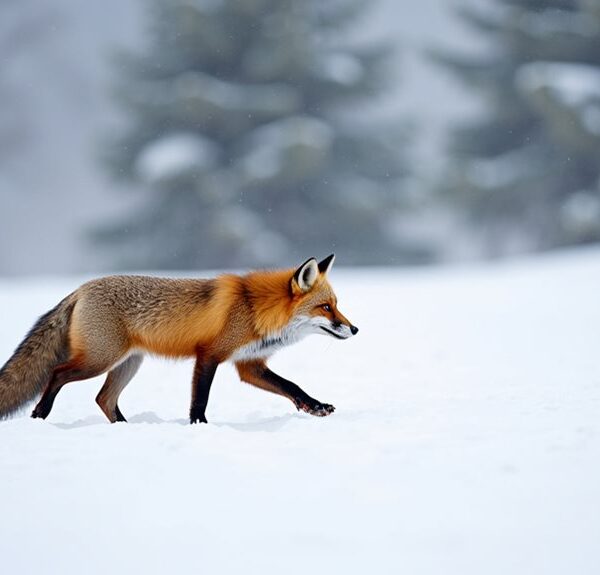

A single line of delicate prints crosses fresh snow in your backyard, each impression no wider than a silver dollar, arranged in an almost perfectly straight line. You kneel closer and notice something remarkable: the track pattern looks like someone drew it with a ruler, each print landing directly in front of the last. You’ve just discovered fox tracks,one of nature’s most elegant signatures and a window into the secretive world of vulpine behaviour.
Learning to identify fox tracks transforms ordinary walks into detective work. Whether you’re a wildlife enthusiast documenting urban foxes in your neighbourhood or a nature photographer hoping to anticipate where these elusive canids might appear, understanding their paw prints opens doors to observing behaviours most people never witness. The tracks tell stories: where a fox hunted, how it moved through territory, even clues about its size and health.
This field guide will teach you to distinguish fox tracks from similar species, interpret gait patterns, and read the landscape like a naturalist. By the end, you’ll recognize the subtle signatures that separate a red fox’s diamond-shaped print from a coyote’s rounder impression, skills that connect you more deeply to the wild creatures sharing your ecosystem.
Key Takeaways
- Fox tracks measure 1.75-2.5 inches long with a distinctive diamond or oval shape and four toe pads arranged asymmetrically around a chevron-shaped heel pad
- The direct-register walking pattern creates a nearly straight line of prints, distinguishing fox tracks from the staggered pattern of domestic dogs
- Claw marks appear as fine points extending from toe pads, unlike the blunt, prominent claws typical of dog tracks
- Seasonal and substrate variations significantly affect track appearance, snow, mud, sand, and dust each reveal different details
- Track identification combines print morphology with trail patterns, habitat context, and associated sign like scat and scent marking
Understanding Fox Track Anatomy and Measurements
The Basic Structure of Fox Paw Prints
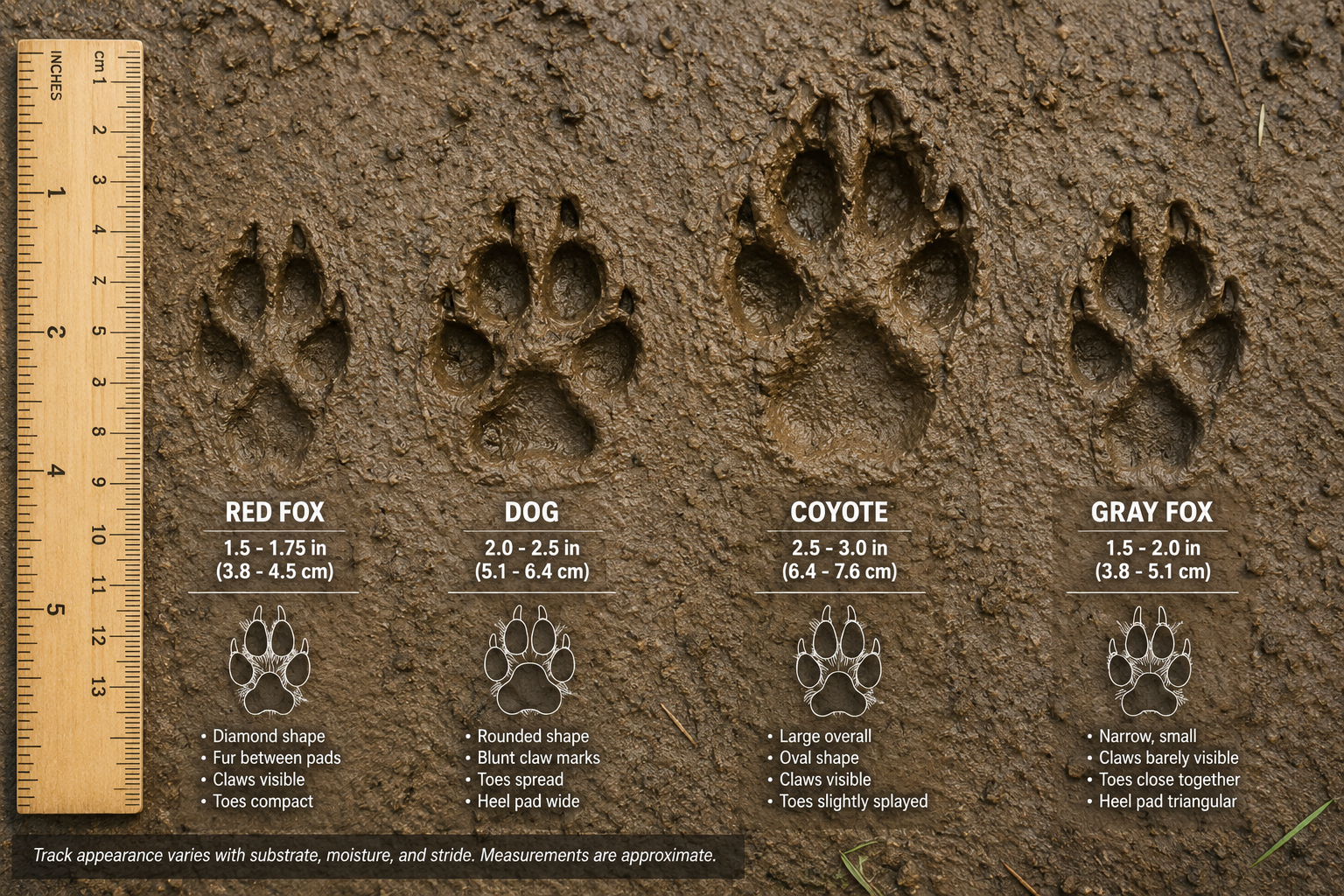
A fox’s front paw print differs subtly from its hind print, though both share the same fundamental architecture. The front track typically measures 1.75 to 2.5 inches (4.5-6.5 cm) in length and 1.5 to 2 inches (4-5 cm) in width for red foxes, the most commonly encountered species across the red fox range of North America, Europe, and Asia. Gray foxes leave slightly smaller impressions, while Arctic foxes produce heavily furred tracks that can appear larger than their actual pad size.
Each print shows four toe pads arranged in a gentle arc around a central heel pad (also called the metacarpal or metatarsal pad). The heel pad displays a distinctive chevron or inverted-V shape with a curved front edge and a rear edge that often shows a tri-lobed or W-shaped pattern. This chevron configuration is your first diagnostic feature, it’s more pronounced in fox tracks than in domestic dog prints.
The negative space between the toe pads and heel pad forms a crucial identification marker. In fox tracks, you can often draw an imaginary “X” through the print, with the cross-point falling in the open space between the toes and heel. This diamond-shaped or oval negative space distinguishes fox prints from the more circular, compact arrangement seen in dog tracks.
Claw marks appear as fine, sharp points extending from each toe pad, typically adding 1/8 to 1/4 inch to the overall track length. Fox claws are semi-retractable (though not to the degree of cat claws), so in firm substrates or when the fox is moving carefully, claw marks may be faint or absent. This contrasts sharply with domestic dogs, whose non-retractable claws leave bold, blunt marks in nearly every print.
Distinguishing Features from Similar Species
The challenge in track identification lies not in seeing a print, but in confidently separating it from similar canids. Here’s how fox tracks differ from their most common look-alikes:
Fox vs. Domestic Dog: Dog tracks appear rounder and more symmetrical, with toe pads that splay outward more noticeably. The heel pad in dog tracks lacks the sharp chevron shape and tends to be proportionally larger relative to the toe pads. Most tellingly, dog tracks show prominent, blunt claw marks in nearly every print, while fox claws appear as delicate needle-points. The negative space in dog tracks forms a rough circle or oval, not the distinctive diamond of fox prints.
Fox vs. Coyote: Size provides the first clue, coyote tracks typically measure 2.5 to 3.5 inches long, noticeably larger than fox prints. Coyote tracks also appear more elongated and less delicate, with a heel pad that’s proportionally larger. The toe pads in coyote tracks tend to be more robust and less refined than the dainty impressions foxes leave. However, a large male fox can leave prints similar in size to a small female coyote, making trail pattern analysis essential for confirmation.
Fox vs. Cat: Domestic and wild cat tracks show a rounder overall shape with a tri-lobed heel pad that’s distinctly different from the chevron pattern of foxes. Most importantly, cat tracks rarely show claw marks due to their fully retractable claws, and the toe pads appear more symmetrically arranged in a semi-circle. Cat tracks also lack the elongated, diamond-shaped negative space characteristic of fox prints.
For a comprehensive comparison of key features for fox species identification, including track variations among red, gray, and Arctic foxes, additional resources can help refine your identification skills.
Variations Among Fox Species
Red Fox (Vulpes vulpes): The most widespread fox species leaves the “classic” fox track described above. Front prints measure 1.75-2.5 inches, with hind prints slightly smaller at 1.5-2.25 inches. The heel pad shows a pronounced chevron, and the overall impression appears delicate and refined. During winter in northern regions, heavy fur growth between the pads can blur track edges and make prints appear larger and less defined.
Gray Fox (Urocyon cinereoargenteus): Slightly smaller than red fox tracks, gray fox prints measure 1.5-2 inches in length. The most distinctive feature is the semi-retractable claws, which may not register at all in firm substrates, a characteristic that can cause confusion with bobcat tracks. Gray foxes also possess a unique ability to climb trees, and you may find their tracks leading up to or descending from tree trunks near den sites.
Arctic Fox (Vulpes lagopus): These northern specialists develop extremely heavy fur on their paws as winter insulation, creating tracks that appear disproportionately large (2-3 inches) relative to the fox’s body size. The fur often obscures individual pad details, leaving rounded, almost snowshoe-like impressions. Summer tracks, when the insulating fur is absent, appear much smaller and more defined, measuring closer to red fox dimensions.
Kit Fox (Vulpes macrotis) and Swift Fox (Vulpes velox): These diminutive western species leave the smallest fox tracks in North America, measuring just 1.25-1.75 inches. The prints maintain the characteristic fox morphology but at a scale that can be confused with large house cat tracks. Habitat context becomes crucial, kit foxes inhabit arid regions where you’d rarely encounter domestic cats far from human habitation.
Interpreting Fox Track Patterns and Gaits
The Direct-Register Walk
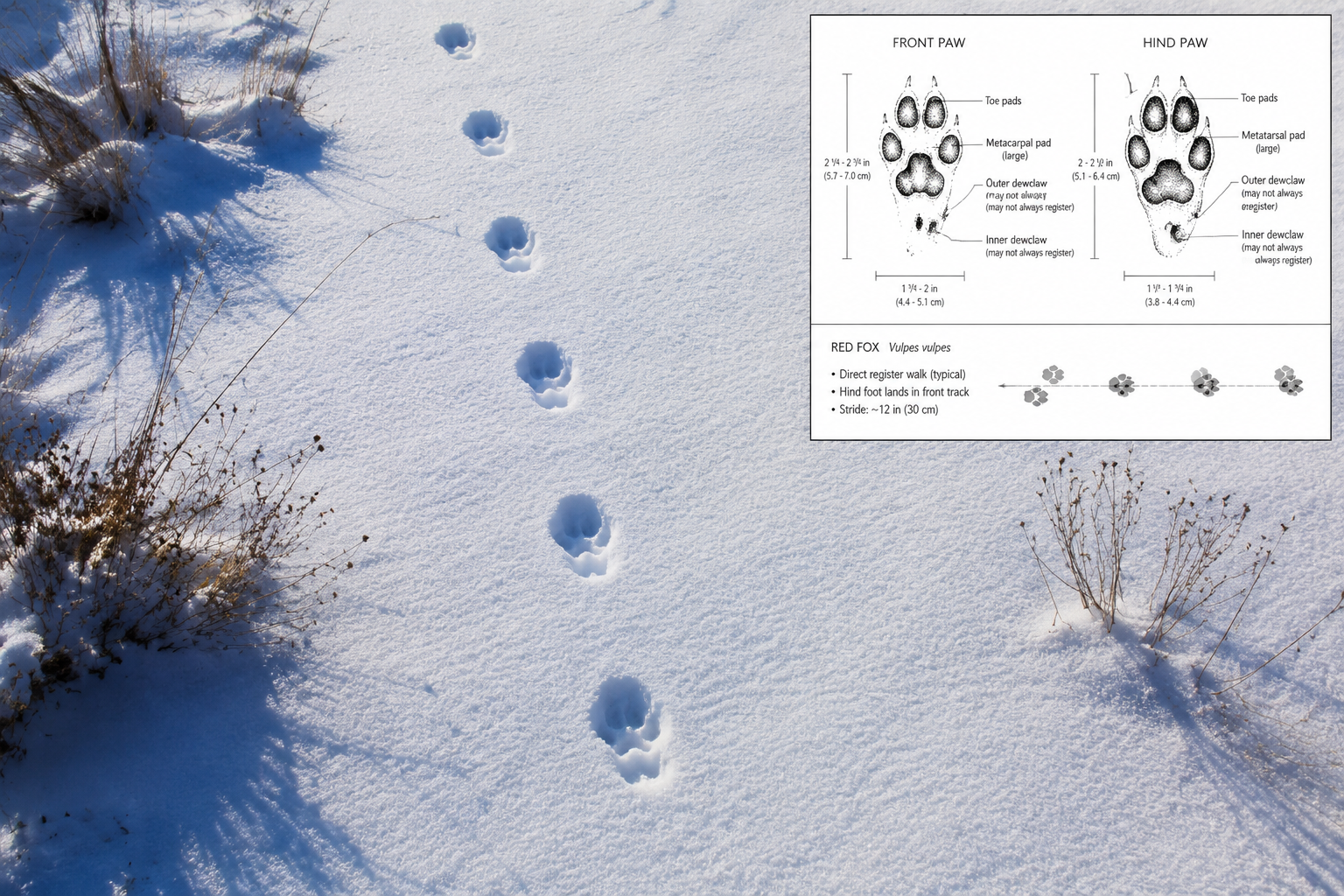
The most diagnostic feature of fox tracks isn’t the individual print, it’s the trail pattern they create. Foxes typically move in a direct-register walk, where the hind foot lands precisely in (or very close to) the print left by the front foot on the same side. This creates a characteristic single line of tracks that appears almost ruler-straight, with prints spaced 12-18 inches apart for adult red foxes.
This efficient gait conserves energy and minimizes noise, crucial adaptations for a predator that relies on stealth. The direct-register pattern also reduces the number of scent trails the fox leaves, making it harder for larger predators to track. When you see this neat, straight line of prints crossing a field or following a fence line, you’re witnessing the signature of vulpine behaviour optimized over millennia.
In contrast, domestic dogs typically use a staggered walk pattern, where the hind foot lands beside (not in) the front footprint, creating a wider trail with prints arranged in a zig-zag or double-line pattern. This single difference allows confident identification even when individual prints are unclear.
Other Gait Patterns
Trotting: When moving faster, foxes shift to a trot that maintains the direct-register pattern but increases stride length to 18-24 inches. The prints may show slight side-by-side placement rather than perfect overlap, creating a paired pattern. Trotting tracks often appear along travel corridors, fence lines, field edges, or trails, where foxes move between hunting areas and den sites.
Galloping: When hunting or fleeing, foxes break into a gallop that creates clusters of four prints with significant space between each cluster. The hind feet land ahead of the front feet, creating a distinctive “rocking horse” pattern. These tracks often appear in open areas where foxes pursue prey or near locations where they’ve been startled. The distance between track clusters can exceed 6-8 feet for an adult red fox at full speed.
The Mousing Leap: One of the most spectacular fox behaviours leaves an equally dramatic track pattern. When hunting small mammals under snow, foxes perform a characteristic high arc jump, landing with front feet together in a precise strike. The resulting track shows both front prints side-by-side, followed by hind prints landing in the same spot, with a launching point several feet behind. This pattern, combined with a nose-dive impression in snow and possible blood or fur, tells the complete story of a hunting attempt.
Reading Track Patterns for Behaviour
Track patterns reveal more than just species identification, they’re a narrative of behaviour and intent:
Hunting patterns: Meandering trails with frequent direction changes, pauses (where all four feet register together), and sudden gallop bursts indicate active hunting. Look for tracks that circle back on themselves or investigate every brush pile, log, and rock outcrop, signs of a fox systematically working an area for prey.
Travel corridors: Straight, purposeful trails with consistent direct-register walking indicate a fox moving between locations. These often follow the easiest terrain, ridge tops, frozen stream beds, or human-made features like roads and trails. During mating season (January-March in most regions), you may find paired tracks of a male and female traveling together.
Territorial marking: Look for tracks that pause at prominent features, rocks, stumps, fence posts, where foxes deposit scent marks. The fox may scratch the ground after marking, leaving distinctive scrape marks with the hind feet. These scent posts cluster along territorial boundaries and near den sites.
Den activity: Multiple trails converging on a single location, often with tracks of varying sizes (adult and kits), indicate an active den site. During spring and early summer, you’ll find well-worn paths radiating from den entrances, along with prey remains, scat, and the distinctive musky odor of fox. For more on how scientists track urban foxes and monitor den sites, research methods provide additional insights into interpreting these activity centers.
Seasonal and Substrate Considerations
How Different Surfaces Affect Track Appearance
Snow: The ideal medium for track identification, snow preserves fine details like claw marks, fur impressions between pads, and the subtle asymmetry of toe arrangement. Fresh, shallow snow (1-3 inches) shows the clearest prints. Deep, powdery snow causes prints to collapse inward, obscuring details and making tracks appear larger and less defined. Crusty snow may only show the tips of toes and claws, creating partial impressions that can be challenging to identify.
Mud: Firm, damp mud rivals snow for detail, capturing the complete pad structure and often showing the texture of the pad surface. However, mud tracks can distort as they dry, shrinking, cracking, or expanding depending on clay content. Very soft mud allows prints to sink deeply and spread, making them appear larger than actual pad size. The best mud tracks appear along stream banks, dirt roads after light rain, and the edges of puddles.
Sand: Dry sand rarely holds clear tracks, as the loose substrate collapses into prints almost immediately. Damp sand near water provides better definition but still tends to blur fine details like claw points and pad texture. Beach sand, especially in the firm zone between high and low tide, can preserve recognizable tracks, though wind and waves quickly erase them.
Dust: Fine dust on trails or dirt roads can show surprisingly clear tracks, especially in arid regions where kit foxes and gray foxes are common. Dust tracks appear as negative impressions, darker areas where the fox compressed the surface. These tracks are extremely ephemeral, disappearing with the slightest breeze.
Hard surfaces: Packed dirt, pavement, and rock rarely show clear tracks unless the fox has walked through mud or water first, leaving temporary wet prints. However, you may find scratch marks on wood or bark where foxes have climbed (gray foxes) or marked territory.
Seasonal Variations in Track Appearance
Winter: Cold-weather tracks show the most variation due to fur growth. Northern foxes develop heavy fur between their toe pads as insulation, which can blur track edges and fill in the negative space that’s so diagnostic in other seasons. In extreme cold, this fur can make individual toe pads nearly indistinguishable, leaving rounded impressions that resemble small dog tracks. However, the trail pattern, that characteristic straight line, remains consistent.
Spring: As foxes shed their winter coats, tracks become more defined again. This is also the season of peak den activity, when adult foxes are provisioning kits. You’ll find the most tracks near den sites during April through June, with smaller kit tracks appearing alongside adult prints as young foxes begin exploring outside the den. For more information on baby foxes and kit development, seasonal patterns provide context for track interpretation.
Summer: Tracks appear at their most refined during warm months, with minimal fur between pads and maximum pad definition. However, summer also brings the challenge of dry, hard ground that doesn’t hold tracks well. Focus on dust, damp areas near water sources, and muddy spots after rain.
Autumn: Fall tracks show moderate fur development and often appear along travel routes as foxes cache food for winter. You may find tracks leading to buried prey items, with disturbed soil or vegetation marking cache sites. This is also dispersal season for young foxes, so you may encounter tracks of inexperienced juveniles in unusual locations.
Associated Sign and Track Context
Scat and Scent Marking
Fox tracks rarely appear in isolation. Learning to recognize associated sign strengthens identification confidence and reveals behaviour patterns:
Fox scat typically measures 2-4 inches long and 1/2 inch in diameter, appearing twisted or rope-like with tapered ends. The contents reflect diet, fur and bone fragments from small mammals, seeds and berries during autumn, insect parts in summer. Fox scat often contains more hair than coyote scat and appears darker and more twisted than dog feces. Foxes frequently deposit scat on prominent objects (rocks, stumps, trail intersections) as territorial markers, and you’ll often find tracks approaching and leaving these scent posts.
Urine marking appears as yellow staining in snow or dark spots on vertical surfaces. Foxes mark with remarkable precision, often targeting the same spots repeatedly. Male foxes mark more frequently than females, especially during mating season, and you may find tracks where a fox has paused, lifted a leg, and marked a specific feature.
Hunting Sign and Prey Remains
The forensic value of fox tracks extends to understanding predator-prey relationships:
Mousing craters in snow show where a fox has plunged nose-first after hearing a vole or mouse moving beneath the surface. The track pattern shows the launching point, the dive impression (sometimes with a perfect nose print), and the landing site. Successful hunts may leave blood spots, fur, or small bone fragments.
Cached prey: Foxes often bury surplus food, and tracks leading to disturbed soil or snow with no obvious destination suggest a cache site. The fox may return multiple times, creating a network of trails converging on the hidden food.
Feathers and fur: Foxes are opportunistic predators, and their tracks near bird or rabbit remains tell stories of successful hunts. Unlike larger predators that consume prey on-site, foxes often carry smaller prey items back to dens or cache sites, creating drag marks alongside the track trail.
Habitat Context
Track interpretation improves dramatically when you consider habitat:
Urban and suburban areas: Urban foxes create tracks in gardens, parks, and along greenways. Look for prints near compost bins, bird feeders (where they hunt rodents attracted to spilled seed), and under decks or sheds that serve as den sites. Urban fox tracks often follow human infrastructure, sidewalks, fence lines, and alleyways, using these features as efficient travel corridors.
Agricultural landscapes: Fox tracks appear along field edges, hedgerows, and irrigation ditches where rodent populations are highest. The direct-register pattern is especially evident in plowed fields, where the straight line of prints crosses open ground between cover patches.
Forest and woodland: In forested areas, fox tracks follow game trails, logging roads, and stream corridors. Look for tracks on fallen logs (especially gray foxes, which readily climb), around brush piles, and near rocky outcrops that might harbor dens.
Grasslands and prairies: Open country tracks often show hunting patterns, the meandering, investigative trails of a fox working through grass for small mammals. Kit foxes and swift foxes in western grasslands create tracks near prairie dog colonies and ground squirrel burrows, their primary prey base.
Practical Tips for Track Documentation
Field Techniques
Photography: Photograph tracks with a scale reference (ruler, coin, or your hand) placed beside, not in, the print. Take shots from directly overhead to avoid perspective distortion, and include both close-ups of individual prints and wider shots showing the trail pattern. Photograph in good light, ideally with the sun at an angle that creates shadows in the track depressions, enhancing detail.
Measurements: Record track length and width, stride length (distance between consecutive prints on the same side), and trail width (the width of the overall pattern). Note the substrate, weather conditions, and any associated sign. These measurements, combined with photographs, create a permanent record for later analysis.
Casting: Plaster or dental stone casts preserve three-dimensional track details. Mix the casting material to a thick, pancake-batter consistency, pour gently into the track, and allow 30-45 minutes to set before lifting. Casts capture details that photographs miss and create tangible references for comparison.
Sketching: Even rough field sketches help train your eye to see diagnostic features. Draw the overall track shape, note the arrangement of toe and heel pads, mark the negative space pattern, and indicate claw positions. The act of drawing forces careful observation that improves identification skills.
When to Seek Expert Confirmation
Some tracks defy confident field identification. Partial prints, degraded tracks, or prints from unusual species may require expert analysis. Wildlife biologists, experienced trackers, and naturalist organizations can provide confirmation. Online tracking communities and forums allow you to share photographs for identification help, though always include scale references and habitat context.
For researchers and wildlife managers, camera traps placed near track trails can confirm species identity by capturing the animal that made the prints, providing definitive verification and additional behavioral data through fox population tracking.
FAQ
How can I tell if fox tracks are fresh or old?
Fresh tracks show sharp, crisp edges with no degradation from weather. In snow, fresh prints have clean walls and fine details like claw marks are clearly visible. In mud, fresh tracks appear damp with no cracking or drying. Old tracks show rounded edges, collapsed walls, and may be partially filled with debris, new snow, or dried mud. In snow, wind erosion and sun exposure enlarge and blur old tracks within hours. As a general rule, tracks less than 24 hours old in stable conditions retain most diagnostic details.
Can fox tracks appear in my suburban backyard?
Absolutely. Urban and suburban foxes are increasingly common across North America and Europe, adapting remarkably well to human-modified landscapes. Foxes visit yards to hunt rodents, investigate compost bins, and travel between den sites and foraging areas. If you find fox tracks in your yard, it indicates a healthy local ecosystem with sufficient prey and cover. Most fox visits occur during nocturnal habits, between dusk and dawn, so you may never see the fox itself, only its tracks as evidence of nighttime activity.
What’s the difference between front and hind fox tracks?
Front tracks are typically larger (1.75-2.5 inches for red foxes) and wider than hind tracks (1.5-2.25 inches), with more prominent heel pads. The front foot carries more weight and leaves a deeper impression. However, in the direct-register walking pattern, the hind foot lands in or very near the front footprint, making individual distinction difficult in trail patterns. When all four feet register separately (in slow walking or when the fox pauses), you can see that hind tracks appear slightly narrower and more elongated than front tracks.
Do fox tracks always show claw marks?
Not always. Fox claws are semi-retractable, and in firm substrates or when moving carefully, claw marks may be faint or absent. This is especially true for gray foxes, which have more retractable claws than red foxes due to their tree-climbing adaptations. However, most fox tracks in snow, mud, or dust show at least faint claw marks extending as fine points from the toe pads. The presence of delicate, needle-like claw marks (when visible) helps distinguish fox tracks from the blunt, prominent claws of domestic dogs.
How do I distinguish between a large fox and a small coyote track?
Size overlap between large male foxes and small female coyotes creates identification challenges. Focus on track morphology rather than size alone: fox tracks show a more pronounced diamond-shaped negative space, a sharper chevron pattern in the heel pad, and more delicate, refined overall appearance. Coyote tracks appear more robust and elongated with a proportionally larger heel pad. Most importantly, examine the trail pattern, foxes maintain a narrow, direct-register walk creating a nearly straight line, while coyotes typically show a wider trail with less precise foot placement.
What time of year are fox tracks easiest to find?
Winter provides the best tracking conditions, especially after fresh snowfall. Snow preserves fine details and makes tracks highly visible against the white background. Additionally, foxes are most active during mating season (January through March in most regions), increasing track abundance. Spring also offers good tracking near den sites as adult foxes provision kits, creating well-worn trails. Summer and autumn tracking depends more on finding suitable substrates like mud, dust, or damp sand, as hard, dry ground doesn’t hold tracks well.
Conclusion
Mastering fox track identification transforms every outdoor experience into an opportunity for discovery. The elegant diamond-shaped prints, arranged in that characteristic straight line, become a familiar signature, evidence of the secretive, intelligent creatures sharing your landscape. Whether you’re tracking red foxes across snowy fields, documenting gray fox movements through suburban greenways, or studying kit fox behaviour in western grasslands, the skills outlined in this guide provide a foundation for deeper wildlife observation.
Start with the basics: learn to recognize the chevron-shaped heel pad, the diamond negative space, and the delicate claw marks that distinguish fox tracks from similar species. Practice reading trail patterns, understanding that the direct-register walk tells as much about species identity as individual print morphology. Pay attention to habitat context, seasonal variations, and associated sign that complete the story tracks begin to tell.
As you develop these skills, consider documenting your observations through photography, measurements, and field notes. Your records contribute to understanding fox distribution, behaviour, and adaptation to changing landscapes, valuable data for conservation and wildlife management. Most importantly, tracking connects you to the natural world in immediate, tangible ways, revealing the hidden lives of creatures that move through familiar places unseen.
The next time you encounter a line of prints crossing fresh snow or pressed into damp earth, you’ll have the knowledge to read that signature with confidence, understanding not just what made the tracks, but where the fox was going, what it was doing, and how it moves through the world with such remarkable efficiency and grace.