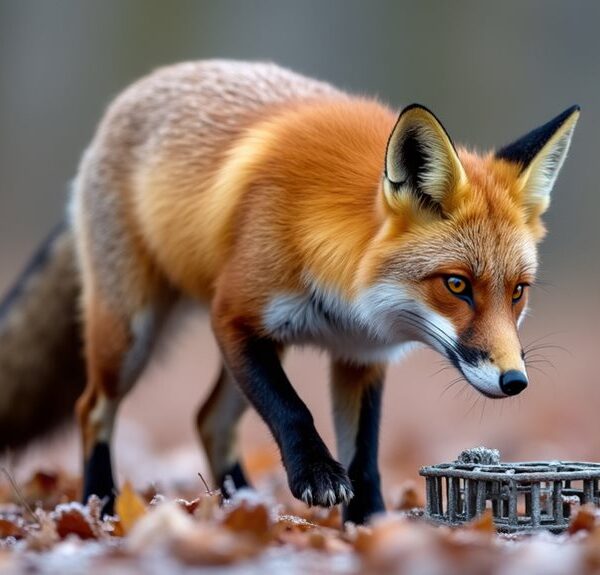

Foxes communicate through an impressive repertoire of over 40 vocalizations, from blood-curdling screams to gentle murmurs. They’ll create detailed “scent maps” using urine and scat to mark territories and signal reproductive status. You’ll notice their expressive body language too—a wagging tail shows excitement, while flattened ears indicate fear or aggression. Parent foxes use specific calls to teach cubs survival skills, while urban foxes adapt their communication style compared to their rural counterparts. The fascinating nuances of their communication system reveal nature’s remarkable complexity.
The Fox’s Vocal Repertoire: From Screams to Whispers

When you hear a strange, haunting cry echo through the night, you might be listening to a fox’s voice—one of nature’s most versatile vocal performers.
These clever canids possess an impressive range of sounds that’ll surprise you with their vocal intensity, from high-pitched screams that send shivers down your spine to soft, gentle whispers used for close communication with their kits.
You’ll notice that foxes don’t just bark like dogs. Through communication evolution, they’ve developed about 20 different vocalizations including yaps, growls, whines, and a distinctive “wow-wow-wow” contact call.
They’ll adjust their volume depending on the situation—screaming loudly during mating season or quietly murmuring to their young. It’s their way of maneuvering through the complex social world and survival challenges they face daily. Additionally, their vocalizations serve essential communication functions that strengthen social bonds and alert others to danger.

The all-in-one audio editor: Everything you need to record, edit, restore and master audio. NEW! modernEQ NEW! modernReverb NEW! Advanced editing for effects plug-ins NEW!...
Decoding the Fox’s 40+ Different Vocalizations
While you might think foxes are generally quiet creatures, they actually possess an impressive vocabulary of over forty distinct vocalizations, from high-pitched screams to deep howls and sharp barks.
You’ll notice each sound serves a specific purpose in their communication system, whether they’re alerting others to danger, establishing territory, or coordinating during hunting.
Understanding these diverse sounds helps researchers decode fox behavior, revealing complex social interactions that challenge our assumptions about these clever canids. Additionally, vocal mimicry plays a vital role in how cubs learn effective communication skills through observation and play.
The Silent Majority Myth
Despite popular belief that foxes are silent creatures, these clever canids actually possess one of the most diverse vocal repertoires in the animal kingdom.
You’ve probably heard their haunting screams on winter nights, but that’s just the beginning of their sonic world.
The myth that foxes communicate primarily through silent means simply doesn’t hold up to scientific observation. While they do utilize body language and scent marking in their social dynamics, vocalizations form the cornerstone of their interactions.
From gentle murmurs between mates to warning barks when territory is threatened, foxes are surprisingly chatty. Their vocal signals, along with body language cues, help convey emotions and intentions effectively.
Next time you’re near fox habitat, listen carefully—you might hear chirps, yips, or even something resembling a human baby’s cry.
These aren’t rare occurrences; they’re the fox’s everyday conversation.
Bark, Scream, Howl
The fascinating world of fox vocalizations encompasses over 40 distinct sounds, forming a complex language that scientists are still working to fully decode.
You’ll notice different bark types depending on the situation—short, sharp barks signal danger while chattering barks often indicate excitement or playfulness.
The scream meanings vary widely, and you’ve probably heard their infamous night screams that sound eerily human. These calls reach remarkable vocal intensity during mating season, when foxes communicate territorial boundaries and availability.
- A fox’s bark resembles a dog’s but with a higher pitch and more staccato rhythm
- Their blood-curdling screams can make the hair on your neck stand up
- Gentle howl variations communicate long-distance with family members
In addition to vocal sounds, foxes also rely heavily on scent marking to establish territory and communicate reproductive status.
The next time you hear these sounds, you’re witnessing a sophisticated communication system developed over thousands of years.
Deciphering Fox Meaning
Listening to the rich tapestry of fox vocalizations leads us into a fascinating challenge—deciphering what each sound actually means. When you hear a fox’s high-pitched “wow-wow-wow” call in winter, you’re likely witnessing part of their mating ritual.
Their communication evolution has produced an impressive vocabulary that changes with seasons and situations. Fox behavior patterns reveal that short, sharp barks often signal danger, while the infamous “scream” typically comes from females during breeding season.
You’ll notice cubs make softer, chirping sounds when content but switch to urgent contact calls when separated from family. By studying these patterns, scientists have identified specific vocalizations for territorial warnings, friendly greetings, and even expressions of submission. Additionally, vocalizations and body language play crucial roles in establishing social order among foxes.
Learning to interpret these sounds gives you a window into the complex social lives these adaptable creatures lead in our changing world.
Territorial Marking: How Foxes Create Scent Maps
You’ll be amazed at how foxes create intricate “scent maps” using three distinct marking methods.
They establish boundaries with strategic urine deposits, communicate their presence through carefully placed scat, and leave unique chemical signatures from specialized glands. These scent markers serve as a complex communication system, allowing foxes to claim territory, signal their reproductive status, and warn other foxes away from their home range. Additionally, this territorial management highlights the importance of scent marking in defining social structures and hierarchy among foxes.
Urine Boundary Markers
Scent maps, invisible to human eyes but rich with information for foxes, serve as the foundation of vulpine territorial communication.
You’d be amazed at how these clever creatures use urine as their primary boundary-marking tool. When a fox deposits urine along territory edges, it’s not merely relieving itself—it’s creating a powerful olfactory announcement that can last for days, even in rain.
The urine importance can’t be overstated in a fox’s scent marking routine. Their strategic placement creates:
- A “No Trespassing” sign that warns other foxes of claimed territory
- A dating profile that signals reproductive status to potential mates
- A time stamp that tells neighboring foxes when the area was last patrolled
You’ll often find these markers on prominent features like rocks, fallen logs, or tufts of grass. This scent marking behavior is made possible by the specialized scent glands that foxes possess, which enhance their ability to communicate effectively through urine.
Scat Placement Strategies
While urine marks the primary boundaries, foxes employ a second powerful communication method: strategic scat placement.
You’ll find fox droppings deliberately positioned at prominent locations—on rocks, fallen logs, trail intersections, and other raised spots that maximize visibility and scent dispersal.
This isn’t random bathroom behavior; it’s sophisticated territorial messaging. Fox scat contains glandular secretions that create personalized “scent signatures,” allowing other foxes to identify who’s been in the area and when.
Through scat analysis, researchers have discovered these droppings create complex scent trails throughout a fox’s territory.
When you’re hiking and spot fox scat conspicuously placed on a trail marker or rock, you’re witnessing a fox’s version of social media—a status update announcing its presence, health, and territorial claims to any fox passing through the neighborhood. Additionally, the strategic placement of scat is complemented by well-worn trails that indicate frequent movement and activity within their territory.
Gland Secretion Patterns
Beyond the familiar scat deposits, foxes maintain elaborate territorial networks through specialized scent glands that produce unique chemical signatures.
You’ll find these gland functions vary based on season, age, and reproductive status, creating a dynamic scent environment that tells a detailed story to other foxes.
When you’re walking through fox territory, you’re actually crossing an invisible map of scent signals that communicate crucial information.
These scent signatures serve as complex messages:
- Reproductive availability, signaling to potential mates when breeding season approaches
- Territorial boundaries, warning competitors to keep their distance
- Individual identification cards, allowing foxes to recognize familiar neighbors versus strangers
Interestingly, these scent-marking behaviors also support the social hierarchy essential for maintaining their family dynamics.
You mightn’t detect these subtle chemical conversations, but for foxes, these aromatic messages are as clear as billboards on a highway.
The Secret Language of Fox Tails
Foxes tell intricate stories through their tails, communicating emotions and intentions without making a sound. You’ll notice their tails aren’t just fluffy accessories—they’re sophisticated communication tools.
When a fox is relaxed, its tail hangs low, but during moments of excitement, it’ll whip up and wag frantically.
Fox behavior experts have documented distinct tail signals that reveal a fox’s state of mind. A bushy, puffed-up tail signals alarm or aggression, while a tail tucked between the legs indicates submission or fear.
You might spot a fox with its tail straight out behind it when it’s focused on hunting. When two foxes greet each other, they’ll often curve their tails in friendly, questioning arcs—a silent hello that speaks volumes in their social world. Seasonal variations influence social behavior and tail signals, enhancing communication among foxes during different times of the year.
Facial Expressions and Ear Positions: Reading a Fox’s Mood

Much like their expressive tails, a fox’s face reveals a detailed emotional scenery that you’ll learn to read with practice. The subtle facial signals foxes display can tell you whether they’re feeling threatened, curious, or content.
The subtle language of a fox’s face speaks volumes, revealing their emotional state to those patient enough to learn it.
When you’re observing these clever creatures, pay special attention to their ear cues—they’re constantly shifting to communicate different moods.
Here’s what to watch for:
- A relaxed fox holds its ears forward or slightly to the side, with an open facial expression
- Fear or aggression shows in flattened ears pressed against the head, often with bared teeth
- Curiosity appears as perked-up ears, tilted head, and bright, focused eyes
You’ll notice these expressions change rapidly as foxes react to their environment, creating a fascinating emotional language.
Seasonal Changes in Fox Communication Patterns
As the seasons shift from winter’s quiet to spring’s bustling activity, fox communication patterns undergo notable transformations that you’ll notice if you observe them throughout the year. The volume and frequency of fox calls increase dramatically during mating season in late winter, when their distinctive screams pierce the night air more often.
Environmental influences play a noteworthy role in these seasonal vocalizations. During summer months, when foxes are raising kits, you’ll hear more barking and “wow-wow” calls as parents warn their young of potential dangers.
In autumn, territorial marking through scent becomes more prominent as juveniles establish their own ranges.
You’ll also notice that foxes become more vocal during dawn and dusk in spring and summer, taking advantage of sound traveling better in the cooler air.
Parent-Cub Communication: Teaching the Next Generation
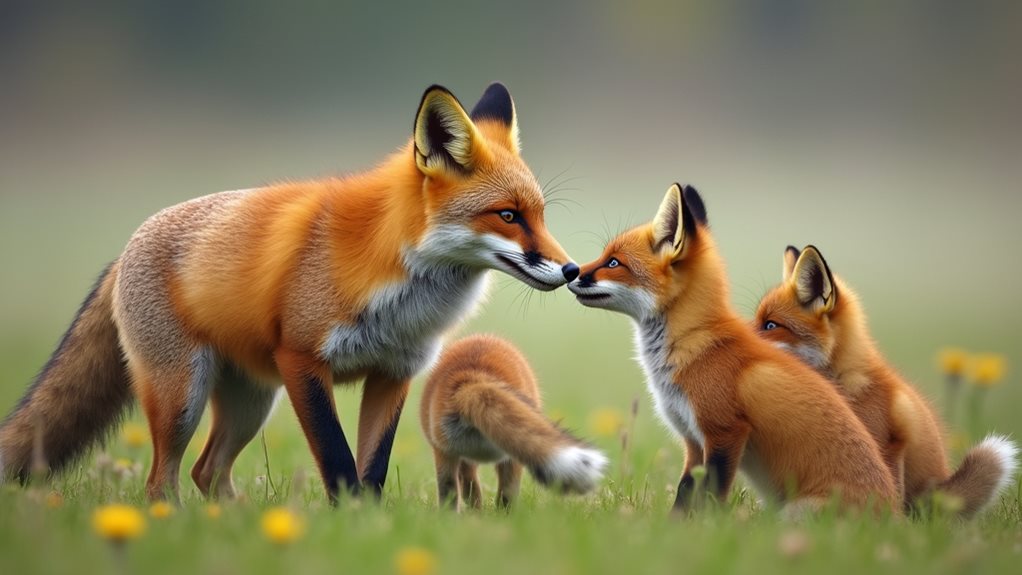
You’ll notice fox parents communicate with their cubs through distinct vocalizations that help establish recognition and bonding from birth.
These auditory signals create a foundation for the family unit, allowing cubs to identify their parents even in the dense underbrush of their woodland homes.
As cubs grow, parents gradually teach crucial survival skills through a combination of demonstrations and gentle corrections, preparing the next generation to steer through the challenges of life in the wild.
Vocalizations and Recognition
Parent-cub communication in foxes represents one of the most fascinating aspects of their social development. While observing fox families, you’ll notice cubs learning to traverse auditory environments through vocal mimicry of their parents’ calls. This recognition system helps maintain family bonds and teaches crucial survival skills.
When fox parents communicate with their young, they create a rich tapestry of sounds that serve multiple purposes:
- A high-pitched “gekkering” sound that alerts cubs to potential danger
- Soft whimpering calls that signal feeding time or reassurance
- Short, sharp barks that function as location markers when families become separated
You’ll find these communication patterns evolve as cubs mature, with parents gradually introducing more complex vocalizations that cubs must learn to interpret correctly in their path toward independence.
Nurturing Survival Skills
Beyond the vocal exchanges between fox parents and their young lies a complex educational system centered on survival skills.
You’ll notice that fox mothers and fathers display remarkable nurturing instincts as they guide their cubs through life’s fundamentals. They’ll demonstrate hunting techniques through playful games, teaching cubs to pounce, stalk, and capture prey with precision.
When you observe fox families, you’re witnessing generations of survival tactics being passed down. Parents will lead cubs on supervised expeditions, showing them how to identify threats, traverse territories, and find reliable food sources.
They’ll even use gentle vocalizations and body language to correct mistakes and reward successful attempts. This educational period is vital – within months, cubs must master skills that will determine their future success in the wild.
It’s a beautiful display of nature’s educational wisdom.
Urban vs. Rural Fox Communication Adaptations
While foxes have thrived for centuries in their native woodland habitats, those living in urban environments have developed fascinating communication adaptations that differ from their rural cousins.
You’ll notice urban fox adaptations include quieter vocalizations to avoid human attention, while rural fox behaviors often feature louder, more frequent calls across open terrain.
When you compare these clever creatures across different environments, you’ll spot these key differences:
- Urban foxes rely more on visual signals and body language at close range, perfect for maneuvering through crowded neighborhoods.
- Rural foxes maintain traditional scent-marking territories that span larger areas.
- City-dwelling foxes have learned to communicate during quieter nighttime hours, reducing conflicts with humans.
These adaptations show how remarkably flexible fox communication can be as they adjust to changing environments.
Cross-Species Communication: How Foxes Interact With Other Animals

Foxes have developed a remarkable ability to communicate across species boundaries, allowing them to maneuver through complex ecological relationships.
You’ll notice these clever canids employ a variety of signals when interacting with potential predators or prey. Their adaptive behaviors include submissive postures when encountering larger predators and strategic vocalizations that can either intimidate or divert attention.
When you observe fox inter-species interactions, you’ll see they’re particularly adept at reading the body language of other animals.
They’ll flatten themselves low when birds of prey soar overhead or raise their hackles when confronting competitive scavengers.
Their communication toolkit extends beyond their own kind, helping them navigate the complex web of wildlife relationships.
This cross-species fluency is one reason foxes have successfully adapted to diverse habitats worldwide.
The Science Behind Fox Communication Studies
For decades, researchers have been captivated by the intricate ways foxes communicate, developing increasingly sophisticated methods to decode their complex language systems.
You’ll find scientists using cutting-edge technology to study how foxes maintain social bonding through their vocalizations and scent marking behaviors.
When you look at communication evolution in foxes, you’ll notice how their signals have adapted to their environments – from dense forests to urban settings.
Scientists often document these fascinating behaviors using:
Sophisticated tools reveal the hidden language of foxes – a symphony of sounds, movements and scents invisible to untrained observers.
- Specialized audio equipment that captures ultrasonic fox calls inaudible to human ears
- Thermal imaging cameras that track subtle body language during nighttime interactions
- Chemical analysis tools that break down the complex scent markers foxes leave behind
You’re witnessing a golden age of fox research, where technology and patience combine to reveal nature’s secrets.
Final Thoughts
You’ve now traversed through the fascinating world of fox communication, where screams become conversations, scents tell stories, and tails speak volumes. You’ll never watch these clever creatures the same way again. Whether they’re teaching their cubs, adapting to city life, or interacting with other species, foxes are not merely surviving—they’re communicating with remarkable sophistication. Next time you spot a fox, you’re not merely seeing an animal; you’re witnessing a natural conversation.