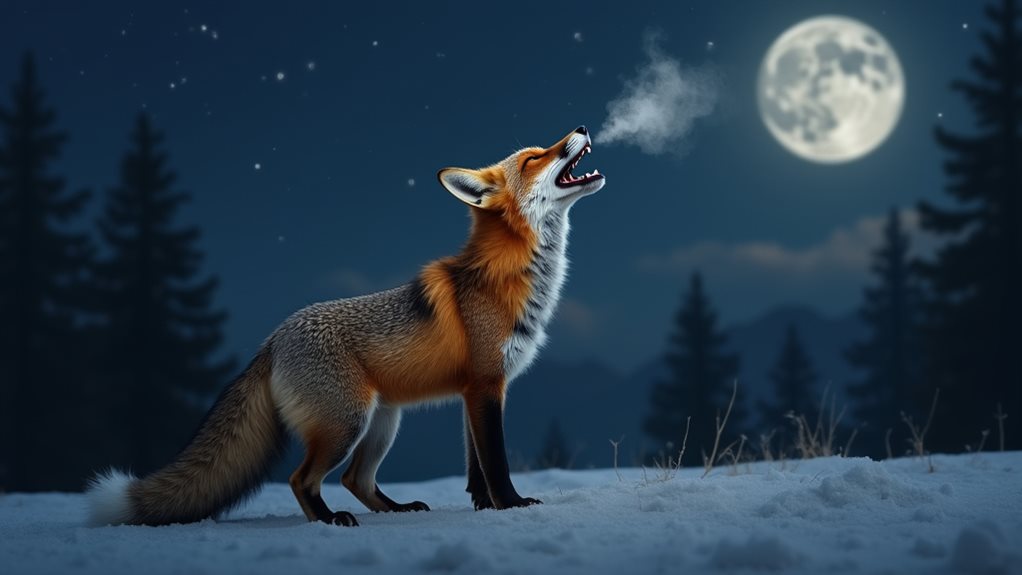
Foxes scream at night primarily during mating season (December-February) and when defending territory. Those chilling, woman-like screams you hear serve multiple purposes: attracting mates, warning competitors, and alerting family to danger. Urban foxes tend to vocalize louder to overcome city noise, while rural foxes use varied calls that travel farther distances. The sound carries exceptionally well in night air, making them seem closer than they actually are. The nocturnal symphony has much more to reveal.
The Unsettling Sound: What Fox Screams Actually Sound Like

The shriek pierces through the darkness, jolting you awake at 3 AM. It’s a sound that’s hard to describe—somewhere between a woman’s scream and a raspy howl—and it’s perfectly normal fox communication.
These eerie vocalizations are often mistaken for someone in distress, but they’re actually just foxes going about their nocturnal behavior. During breeding season (typically January through March), these calls become more frequent as foxes search for mates. Males will produce sharp, loud screams to attract females, while vixens respond with their own high-pitched wails. In urban areas, increased territorial aggression may also contribute to frequent vocalizations as foxes establish their presence.
You’re most likely to hear these unsettling sounds in suburban areas where foxes have adapted to human presence. Their screams carry impressively far in the quiet night air, making them seem closer—and creepier—than they actually are.

Territorial Declarations: Marking Boundaries Through Vocalization
While mating calls account for many fox vocalizations, screaming serves another crucial purpose in a fox’s life—establishing and defending territory. You might hear these territorial declarations when foxes want other foxes to know exactly where their boundaries lie.
Their impressive vocal range allows them to communicate effectively across woodland and urban environments alike.
- Foxes use different sound frequencies to indicate territorial boundaries
- Higher-pitched screams often signal warnings to intruders
- Their vocalizations can travel up to a mile in quiet conditions
- Each fox family develops unique vocal “signatures” that identify them
- Territorial screams increase during breeding season when competition is fierce
- Understanding vocalization methods is essential for interpreting their communication.
Next time you hear that eerie nighttime scream, remember you’re witnessing nature’s “No Trespassing” sign—a fox letting everyone know exactly whose turf you’re on!
Mating Season Communication: The Science Behind Fox Courtship Calls

You’ll notice the eerie screams of foxes intensify during mating season, when hormones trigger these haunting calls that help potential partners find each other. These distinctive vocalizations aren’t just random noise—they’re carefully designed to attract mates while simultaneously warning competitors to stay away. The complex patterns of these courtship calls reveal fascinating insights into fox communication, showing how these clever creatures balance attraction and territory defense during their breeding season. During this time, males communicate through vocalizations that assert their dominance and establish their territory.
Vocalizations Attract Mates
During mating season, fox screams transform into nature’s own dating app, serving as powerful vocal advertisements for potential mates.
These high-pitched calls showcase a fox’s impressive vocal range and play an essential role in their mating behaviors. You’ll hear these distinctive sounds primarily during winter months when foxes are looking for love.
- Female foxes use screams to signal their reproductive readiness
- Males respond with shorter, bark-like calls to express interest
- The intensity and frequency of calls indicate a fox’s health and vigor
- Screams can travel up to a mile in quiet rural areas
- Each fox has a slightly unique vocal “signature” that potential mates recognize
In addition, the copulation duration averages about 26 minutes, demonstrating the investment foxes make in their mating rituals.
When you hear those eerie screams piercing the night, you’re witnessing nature’s romance in action—foxes simply looking for their perfect match.
Hormonal Influence Analysis
These distinctive fox love calls are driven by powerful hormonal changes occurring within their bodies. During mating season, which typically falls between December and February, you’ll notice foxes become considerably more vocal as their hormonal fluctuations reach peak levels.
These internal chemical messengers fundamentally transform their usual behavior, triggering the notorious screaming that might wake you at night.
Female foxes experience the most dramatic hormonal shifts, and their screams serve as powerful advertisements of fertility status. Males respond to these cues with their own vocalizations, creating what you might hear as an eerie nocturnal “conversation.”
What’s fascinating is how these hormonal changes coordinate mating behaviors across fox populations, guaranteeing most cubs are born during ideal spring conditions. It’s nature’s way of synchronizing fox families with seasonal resource availability! During this time, the fox mating season helps ensure a higher survival rate for the cubs born when food is plentiful.
Territory Declaration Patterns
Fox screams aren’t just about finding love—they’re also powerful territorial statements that establish boundaries in the wild. When you hear those spine-tingling calls echoing through the night, you’re witnessing sophisticated fox behavior that’s evolved over thousands of years.
- Foxes use distinct vocal patterns that vary in pitch and duration to mark different boundary types.
- Each family group develops unique screaming “signatures” that neighboring foxes learn to recognize.
- During territorial disputes, screams can escalate in volume and frequency as tensions rise.
- Urban foxes have adapted their territory calls to penetrate through city noise pollution.
- Screaming intensity typically increases during winter months when resources become scarce.
- These vocalizations demonstrate the importance of territorial boundaries that are vital for managing access to resources and mating opportunities.
You’ll notice these territorial declarations are most common at dusk and dawn when foxes are most active. Their remarkable communication system helps them survive in diverse habitats across the world.
Warning Signals: How Foxes Alert Others to Danger

You’ll often hear foxes scream to alert their family members when they sense danger nearby.
Their piercing calls serve as territorial threat alerts, warning other foxes that predators might be closing in on their den or hunting grounds.
When a fox detects a potential threat like a coyote, owl, or human, it’ll let out that distinctive, eerie scream that carries through the night air, giving its companions precious time to seek safety. This behavior is a critical part of their vocalizations for communication, allowing foxes to navigate their environment more effectively.
Territorial Threat Alerts
When danger approaches a fox’s territory, the distinct, haunting scream serves as a powerful warning signal to other foxes in the area.
You’ll hear these spine-tingling vocalizations when foxes defend their space through territorial aggression. Their screams aren’t just random—they’re sophisticated communication tools that help establish boundaries and keep intruders away.
- Foxes use different scream pitches to indicate various threat levels
- Their vocal mimicry skills allow them to imitate other animals, confusing predators
- Screams are louder and more frequent during breeding season when territories matter most
- Young foxes learn these territorial calls from their parents
- The intensity of screams often correlates with the proximity of the threat
- This behavior is influenced by territorial disputes that shape social dynamics within fox communities.
You might mistake these territorial warnings for someone in distress, but they’re just foxes doing what comes naturally—protecting what’s theirs!
Predator Proximity Warnings
Beyond territorial defense, those blood-curdling screams you hear at night often serve as critical predator proximity warnings for the entire fox community.
When a fox spots a potential threat like a coyote, wolf, or even a domestic dog, it’ll release that distinctive shriek to alert others in the area. This alarm system is especially key during peak nocturnal activity when visibility is limited but dangers remain abundant.
You might notice these warning calls increase during certain seasons when predator behavior becomes more aggressive or food competition intensifies.
The screams are fundamentally saying, “Danger nearby—proceed with caution!” This cooperative warning strategy helps protect vulnerable fox kits and gives adults time to either hide or band together against the threat. Additionally, the use of vocalizations for communication plays a significant role in maintaining family bonds and ensuring collective safety.
Urban vs. Rural Fox Vocalizations: Environmental Influences
Urban and rural foxes communicate in surprisingly different ways, largely influenced by their distinct environments.
You’ll notice that city foxes have developed unique urban adaptations in their vocal patterns compared to their countryside cousins’ rural behaviors.
- Urban foxes often vocalize louder to overcome city noise pollution
- Rural foxes typically use more varied calls spanning longer distances
- City foxes communicate more frequently during nighttime hours when human activity decreases
- Countryside foxes coordinate hunting through specific vocal sequences
- Urban fox screams tend to be shorter but more intense than their rural counterparts
When you’re in the city at night and hear that distinctive scream, you’re witnessing how these clever animals have adjusted their communication style to thrive alongside humans in concrete jungles. Interestingly, nearly 70% of urban foxes have successfully adapted to urban environments, showcasing their resourcefulness.
Seasonal Patterns: When Foxes Are Most Vocal Throughout The Year

Throughout the year, fox vocalizations follow distinct seasonal patterns that align with their breeding and territorial behaviors.
You’ll notice a dramatic increase in fox screams during their mating season, which typically peaks in January and February in most regions. During these winter months, their eerie calls echo through neighborhoods as they search for mates.
By spring, vocalization patterns shift to quieter, more nurturing sounds as foxes raise their young pups.
Spring brings gentler fox sounds as adults communicate softly with their vulnerable newborn kits.
Summer brings teaching moments, with adults demonstrating various calls to their offspring.
Come fall, you might hear increased territorial barks as young foxes disperse to establish their own territories.
These seasonal behaviors aren’t just random—they’re carefully timed communication strategies that help foxes maneuver their complex social lives throughout the changing seasons.
Distinguishing Fox Screams From Other Wildlife Sounds
How can you tell if that bone-chilling scream in the night is actually a fox and not something else? Wildlife communication can be tricky to decode, but with some sound identification practice, you’ll become an expert at recognizing fox vocalizations.
- Fox screams typically sound high-pitched and raspy, often described as a “waaaah” that ends abruptly.
- Owl hoots are more melodic and rhythmic, lacking the harsh quality of fox screams.
- Coyote howls are longer, more drawn-out, and often occur in group choruses.
- Bobcat screams sound similar but are usually more guttural and intense.
- Raccoon chatters are more chittering and less scream-like, typically shorter in duration.
You’ll know it’s a fox when you hear that distinctive, eerie quality that sounds almost human-like—as if someone is in distress.
Trust me, once you’ve heard it, you won’t forget it!
Cultural Folklore: How Fox Screams Influenced Myths Worldwide

Those haunting fox screams haven’t just startled modern night owls—they’ve shaped cultural mythology across the globe for centuries.
In Japanese fox folklore, the kitsune’s wail is believed to mimic a woman in distress, leading to tales of shape-shifting tricksters who could take human form.
You’ll find similar mythological interpretations in European traditions, where the screaming fox became associated with banshees and omens of death.
Many Celtic communities viewed these eerie calls as spirits of the deceased trying to communicate with the living.
Native American tribes, meanwhile, often portrayed foxes as clever mediators between humans and the spirit world. Their nocturnal cries were considered sacred messages or warnings.
When you hear that distinctive scream tonight, remember you’re experiencing a sound that has sparked human imagination for millennia.
Living With Foxes: Tips For Homeowners During Noisy Seasons
When fox screaming season arrives in your neighborhood, you’ll need practical strategies to maintain your sanity and sleep schedule.
Understanding fox behavior helps you cope with their vocal antics during mating season, typically peaking in winter.
Fox vocal performances are nature’s alarm clocks—knowing their mating rituals helps you prepare for the winter screaming symphony.
- Install white noise machines or use earplugs to muffle those midnight screams
- Secure trash bins with animal-proof locks to prevent attracting foxes
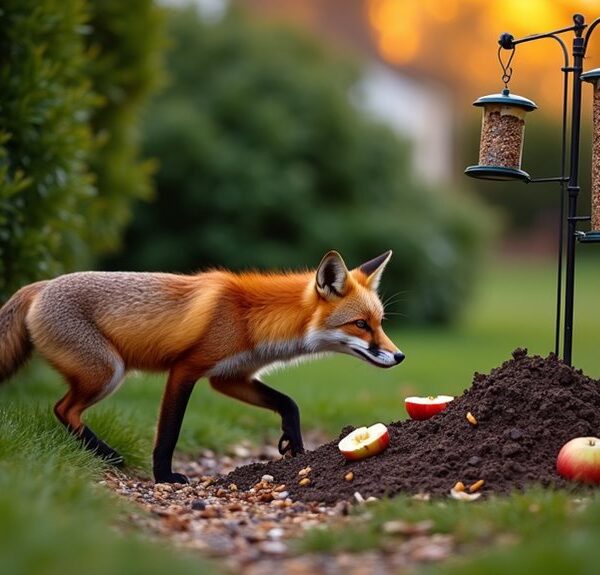
- Remove food sources like pet dishes from your yard after dusk
- Consider motion-activated sprinklers as humane deterrents
- Check for den sites near your property—foxes are noisiest near their homes
Final Thoughts
You’ll never hear anything quite as spine-tingling as a fox’s nocturnal scream—it’s like a horror movie soundtrack right in your backyard! Whether they’re finding mates, marking territory, or warning others of danger, these clever creatures have a million reasons to vocalize. Now that you understand their midnight concerts, you might even appreciate these wild neighbors a bit more. Just don’t expect them to keep it down during mating season—they’ve got important fox business to attend to!