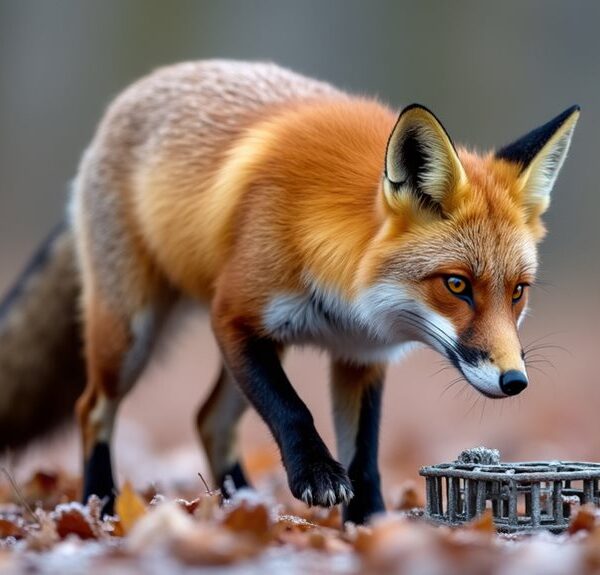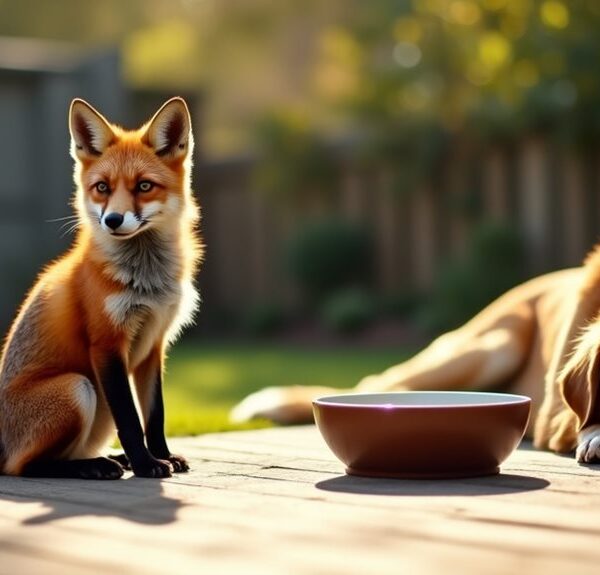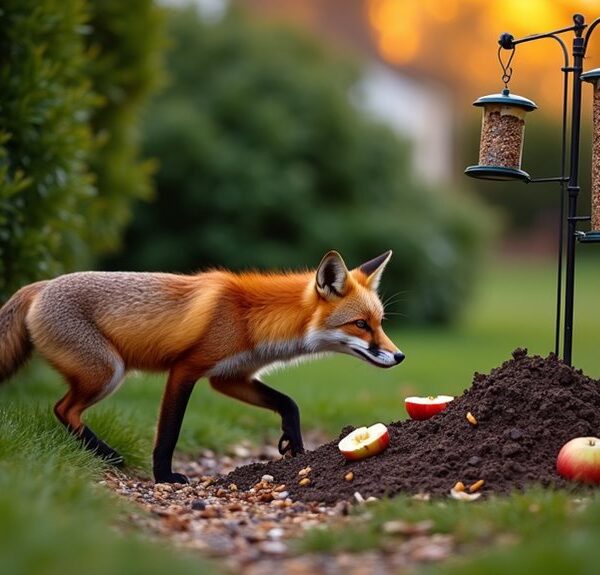

Red foxes survive almost anywhere thanks to their remarkable adaptations. You’ll notice their keen senses—they can hear a mouse squeak from 100 feet away and detect prey under snow. They’ve mastered dietary flexibility, eating everything from berries to small mammals, and even memorize garbage collection schedules in urban areas! Their physical traits, like seasonal coat changes and bushy tails for balance, complement their intelligence. These clever survivors have more secrets to their success than meets the eye.
The Evolutionary History of Red Fox Resilience

When you look at the remarkable expedition of the red fox through time, you’ll find a story of incredible adaptation spanning millions of years.
These clever creatures have maneuvered the shifting terrains of our planet with remarkable genetic diversity, allowing them to thrive in environments from arctic tundra to urban neighborhoods.
The resourceful fox adapts with genetic brilliance, conquering every landscape from frozen wilderness to city streets.
You might wonder how they’ve managed such success! Their trek through evolutionary pressures has shaped them into the resilient animals you see today.
Unlike specialized hunters, foxes developed omnivorous habits that let them eat almost anything—from berries to small mammals. Their adaptable nature isn’t just luck; it’s the result of countless generations facing changing climates and predators.
Their distinctive rusty coat, keen senses, and problem-solving abilities all emerged from this evolutionary dance, creating the crafty survivor you admire today. Moreover, their preferred denning locations reflect their need for safety and resources, showcasing their remarkable adaptability across diverse ecosystems.

Complete Paint by Numbers Kit: Includes a 16x20 inch pre-printed canvas, acrylic paints, 3 matched paintbrushes, instruction manual, hooks, and an original card. Everything you need to create a beautiful painting.


Remarkable Sensory Capabilities for Detecting Prey
The remarkable evolution of red foxes has equipped them with an extraordinary sensory toolkit that makes them formidable hunters.
You’ll be amazed at how their olfactory abilities allow them to detect prey hidden beneath snow or soil. Their auditory sensitivity is so acute that they can hear a mouse squeak from 100 feet away!
- Can hear rodents moving underground or under snow
- Possess specialized olfactory cells that detect minute scent particles
- Their ears rotate independently to pinpoint sound location precisely
- Can see movement in low-light conditions that would leave humans blind
- Use earth’s magnetic field for directional hunting, like a built-in compass
- Their acute sense of smell is essential for locating prey and navigating their territory.
These sensory superpowers aren’t just impressive—they’re vital survival tools that have helped foxes thrive across wildly different environments for thousands of years.
Dietary Flexibility: From Berries to Small Mammals

Red foxes demonstrate remarkable dietary flexibility that sets them apart from many other predators in the wild. You’ll find these clever creatures munching on blackberries and blueberries during summer months, their muzzles stained purple as they efficiently strip shrubs of fruit. Their berry consumption helps them survive when prey is scarce, showing how adaptable they truly are.
Don’t be fooled by their fruit-eating habits, though – these opportunistic hunters excel at mammal hunting too! They’ll patiently stalk field mice, voles, and rabbits, using their incredible hearing to detect movement beneath snow or dense vegetation.
This adaptability allows foxes to thrive in diverse environments from forests to urban settings. Their willingness to eat almost anything – from insects to carrion to your garden fruits – is why these resourceful animals continue to flourish despite changing surroundings. During colder months, they often increase their scavenging efforts to ensure a steady food supply as small mammals become harder to find.
Physical Adaptations for Various Environments
You’ll be amazed at how the red fox’s coat serves multiple essential functions, from insulation in freezing winters to camouflage in various habitats.
Their sensory adaptations form an impressive survival arsenal, with keen hearing that can detect a mouse rustling under snow and whiskers that help steer through total darkness.
These physical adaptations allow red foxes to thrive in environments ranging from arctic tundra to urban neighborhoods, making them one of nature’s most adaptable predators. Additionally, their exceptional hearing ability allows them to detect prey sounds from up to 40 yards away, further enhancing their hunting efficiency.
Versatile Coat Functions
While many animals don seasonal coats, a fox’s fur serves as an impressive multi-functional adaptation that goes well beyond mere temperature regulation.
You’ll notice how a red fox’s coat camouflage changes with the seasons, helping them blend perfectly into their surroundings. Their seasonal shedding isn’t just about staying comfortable—it’s a survival strategy that adapts to changing environments.
- Their dense winter coat traps air for superior insulation
- Water-resistant guard hairs keep foxes dry during wet conditions
- The reddish-brown coloration helps them disappear in forests and fields
- Black-tipped ears and feet reduce heat loss in cold weather
- Their bushy tail serves as both a warm blanket and a balancing tool
- Additionally, the fox’s increased undercoat provides essential warmth during the harsh winter months.
You’re witnessing nature’s perfect design when you spot a fox’s beautiful coat in the wild.
Sensory Survival Arsenal
Beyond their remarkable coat, foxes possess an extraordinary sensory arsenal that enables them to thrive in diverse environments.
You’ll be amazed at how their acute hearing can detect a mouse rustling beneath 3 feet of snow! Their distinctive ears, which can rotate independently, pinpoint auditory cues from prey or predators with impressive accuracy.
Their sense of smell isn’t just good—it’s exceptional. Foxes rely on olfactory communication to mark territories, find mates, and locate food hidden underground.
They’ll even use their nose to determine if an area is safe before settling in for rest.
What’s truly clever is how they combine these senses. When a fox tilts its head while hunting, it’s triangulating sound and smell to create a precise mental map of its surroundings—nature’s GPS system at work! In low-light conditions, their high rod density allows them to see effectively, making them efficient nocturnal hunters.

As cities expand into natural habitats, red foxes haven’t just survived—they’ve thrived, displaying remarkable intelligence that allows them to maneuver through our complex urban environments.
You’ll notice these adaptable creatures have developed fascinating strategies for urban living that showcase their problem-solving abilities.
Urban foxes aren’t just surviving—they’re innovating, turning our concrete jungles into their playground through remarkable adaptability and intelligence.
- They memorize garbage collection schedules, timing their foraging to match your neighborhood’s routine.
- They use man-made structures like drainage systems as ready-made dens and travel corridors.
- They’ve learned to interpret traffic patterns, crossing roads during quieter hours.
- They recognize which humans might provide food and which to avoid.
- They communicate through specific vocalizations that cut through urban noise.
- Additionally, urban foxes have shown behavioral flexibility in adapting to their ever-changing surroundings, indicating their resilience in urban environments.
This urban adaptability shows how foxes continuously evolve alongside human interaction, turning our neighborhoods into their new wilderness.
Seasonal Adjustments in Hunting and Foraging Strategies
Throughout the year, red foxes dramatically shift their hunting and foraging tactics to match nature’s changing buffet. Unlike animals that rely on seasonal migration, these clever creatures stay put and adapt their strategies instead.
You’ll notice foxes hunting more during dawn and dusk in summer, avoiding the day’s heat while demonstrating remarkable temperature tolerance. When winter arrives, they’ll switch to daytime hunting to catch the warmth of the sun.
Their diet transforms too – from primarily hunting mice and rabbits in spring, to feasting on berries and fruits in late summer, then back to small mammals in fall and winter. They’ll even cache extra food when it’s plentiful, creating natural “refrigerators” under soil or leaves for those lean times ahead. This adaptability allows them to thrive on seasonal dietary changes and make the most of available resources.
It’s this flexibility that makes foxes such successful survivors.
The Complex Social Structure of Fox Families

Red foxes maintain social structures that are far more intricate than many people realize.
You’ll find that these clever mammals establish clear social hierarchies within their family groups, often called “skulks.” They don’t just live as solitary hunters—they’ve developed sophisticated systems of communication and cooperation that help them survive in diverse environments.
- Family units typically consist of a mated pair and their offspring
- Dominant vixens (females) often suppress breeding in subordinate females
- Young foxes learn hunting skills through play and observation
- Communication happens through vocalizations, scent marking, and body language
- Cooperative hunting emerges during certain seasons when prey is abundant
- Understanding social hierarchy is vital for appreciating the complex interactions among family members.
When you observe foxes in the wild, you’re witnessing complex social dynamics at work—relationships that have evolved over thousands of years to guarantee their survival.
Denning Behaviors and Territorial Adaptations
You’ll be amazed at how red foxes craft their underground homes, complete with multiple escape tunnels and specialized chambers for raising their young.
When selecting a family den, these clever creatures look for well-drained soil on raised ground, often reusing and expanding abandoned burrows from other animals. Additionally, they prefer well-drained, gravelly soil that provides stability for their dens and allows for easier digging and maintenance.
They’ll mark their territory using scent glands and urine deposits, creating an invisible boundary that tells other foxes, “This area is taken!”
Underground Home Design
When searching for a safe place to raise their young, foxes display remarkable ingenuity in their denning behaviors. You’ll find that these clever mammals choose locations with excellent underground insulation, protecting their kits from harsh weather and predators.
Their dens feature complex tunnel ventilation systems that maintain fresh air circulation while keeping the living chambers cozy.
- Multiple entrance points provide quick escape routes during emergencies
- Separate chambers for sleeping, food storage, and waste management
- Strategic positioning near food sources but hidden from human activity
- Reuse of abandoned badger or rabbit burrows to save digging effort
- Intricate tunnel systems that can extend up to 20 feet in length
You’d be amazed at how these architectural marvels serve as both nurseries and fortresses, demonstrating the fox’s brilliant adaptation to survival challenges.
Territory Marking Methods
Beyond their impressive dens, foxes maintain strict boundaries through sophisticated scent communication systems.
You’ll find these clever creatures employing a variety of scent marking techniques to declare ownership of their hunting grounds. When a fox rubs its tail or body against objects, it’s actually depositing unique scent markers from specialized glands that serve as “No Trespassing” signs to other foxes.
In addition to these aromatic warnings, foxes use visual signals to reinforce their territorial claims.
They’ll strategically scratch tree trunks, dig small holes, or leave partially covered droppings at boundary lines. You might notice these subtle markers while hiking, though you’d probably walk right past them without realizing their significance.
These ingenious methods help foxes avoid unnecessary confrontations while protecting their valuable resources.
Family Den Selection
While scent marking establishes the boundaries, the heart of a fox’s territory lies in its carefully selected den.
You’ll find that den site selection isn’t random—foxes choose locations that provide safety for their growing families while maintaining access to hunting grounds. Family dynamics influence these choices, with the vixen (female fox) often having the final say in where her kits will be raised.
- Sandy soil that’s well-drained prevents flooding during spring rains
- South-facing slopes capture more sunlight, keeping the den warmer
- Multiple entrances offer quick escape routes from predators
- Proximity to water sources without being too close to human activity
- Dense vegetation nearby provides cover for young kits’ first explorations
You’ll notice successful fox families often reuse quality den sites for generations, showing just how important this choice is to their survival.
Reproductive Strategies for Species Success
Although most predators have impressive hunting skills, the red fox’s reproductive adaptations truly set it apart as a survivor. These clever creatures have developed mating rituals that guarantee the strongest genes continue to the next generation.
You’ll find that foxes form monogamous pairs during breeding season, with males competing through vocalizations and displays of hunting prowess.
When it comes to offspring care, red foxes excel at family planning. They’ll typically produce 4-6 kits per litter, a perfect balance between quality parenting and population growth.
Both parents participate in raising young, with mom handling nursing while dad delivers food to the den. You might be surprised to learn that older siblings sometimes stick around to help with the newest litter, creating a cooperative family structure that increases survival rates dramatically.
This teamwork approach guarantees their species thrives despite environmental challenges.
Coexistence With Humans: the Future of Fox Adaptation

Red foxes’ family-centered survival strategies have prepared them well for their next evolutionary challenge: living alongside humans.
You’ll notice these adaptable creatures thriving in urban wildlife settings, making clever adjustments to their behavior patterns and diets.
When it comes to human interaction, foxes have shown remarkable flexibility, finding opportunities where others see obstacles.
They’re learning to maneuver our complex environments while maintaining their wild instincts.
- Foxes now den in abandoned urban structures rather than digging burrows
- They’ve shifted hunting schedules to avoid peak human activity times
- Their diet increasingly includes discarded human food sources
- Urban foxes have developed higher tolerance for noise and light pollution
- They’re teaching survival skills specific to human environments to their kits
Final Thoughts
When you encounter a red fox in the wild, you’re witnessing a marvel of evolution. Their incredible adaptations have helped them weather the storm of environmental changes for centuries. From their keen senses to their social intelligence, foxes haven’t just survived—they’ve thrived. As humans and foxes continue sharing spaces, your understanding of these remarkable creatures will determine whether this delicate relationship flourishes or falters.