

Foxes’ night vision outperforms yours by a remarkable margin. Their eyes contain a reflective layer called the tapetum lucidum that bounces light back through the retina twice, maximizing what they can see in darkness. Their pupils dilate up to 50% more than human eyes, while specialized rod cells detect even minimal movement. When hunting at night, foxes combine this superior vision with acute hearing and sensitive whiskers. Their evolutionary adaptations reveal nature’s ingenious solutions for nocturnal survival.
Contents
- 1 The Science Behind a Fox’s Nocturnal Vision
- 2 Anatomy of the Fox Eye: Specialized for Darkness
- 3 The Reflective Advantage: How the Tapetum Lucidum Works
- 4 Comparing Fox Vision to Human Sight in Low Light
- 5 Hunting by Moonlight: How Foxes Track Prey After Dark
- 6 Vertical Pupils: Nature’s Light Adjustment Mechanism
- 7 Color Perception: What the World Looks Like to Nocturnal Foxes
- 8 Beyond Vision: How Foxes Combine Senses for Night Hunting
- 9 Evolutionary Adaptations: Why Fox Vision Developed This Way
- 10 The Limits of Fox Night Vision: When Even Their Eyes Can’t See
- 11 Final Thoughts
The Science Behind a Fox’s Nocturnal Vision

While you’ve likely spotted a fox darting across your path in the twilight hours, you’ve probably wondered how these clever creatures maneuver so effortlessly in near darkness.
Unlike humans, foxes possess specialized adaptations that improve their nocturnal behavior, giving them a notable advantage during nighttime hunts.
Foxes’ eyes contain a reflective layer called the tapetum lucidum, which acts like nature’s mirror, bouncing light back through their retinas for a second chance at detection. You’ve seen this effect when their eyes shine eerily in your headlights!
Nature’s ingenious design gives foxes a second chance at capturing light, creating that ghostly glow we glimpse on dark roads.
Their hunting techniques rely on this improved vision, along with keen hearing and smell. The fox’s pupils also dilate dramatically in darkness, capturing up to 50% more light than human eyes.
It’s these remarkable adaptations that make foxes such successful nighttime predators.

Premium injected polycarbonate lens, for best-in-class optics Grey lens
Anatomy of the Fox Eye: Specialized for Darkness
Their tapetum lucidum, a reflective layer behind the retina, bounces light back through the eye for a second chance at detection, while their rod-dominant retinal structure prioritizes light sensitivity over color perception. Fox eyes can also dilate dramatically, allowing them to gather every available bit of moonlight as they prowl through the night-shrouded wilderness. Additionally, their wide field of view of about 260 degrees enhances their ability to detect movement and pinpoint prey in the dark.
Tapetum Lucidum Reflective Layer
Deep within a fox’s eye lies the remarkable tapetum lucidum, a specialized reflective layer that fundamentally gives these crafty creatures their night-vision superpowers.
This mirror-like structure sits just behind the retina, reflecting light that passes through the eye back for a second chance at detection. It’s one of nature’s most brilliant nocturnal animal adaptations!
When you’ve spotted a fox’s eyes glowing eerily in your headlights, you’re witnessing the tapetum lucidum in action.
This special feature basically doubles the light available to the fox’s photoreceptors, making them six times more sensitive to light than human eyes.
The tapetum lucidum function is particularly vital during dawn and dusk hunting, when foxes need to spot the slightest movements of prey in dim conditions.
Rod-Dominant Retinal Structure
Beyond the tapetum lucidum’s reflective brilliance, a fox’s night vision magic continues with their rod-dominant retinal structure. When you’re peering into the darkness, you’d wish you’d a fox’s retinal sensitivity!
Their eyes contain a much higher concentration of rod cells compared to cone cells, allowing them to detect even the faintest movements in near-darkness.
The rod distribution across a fox’s retina isn’t random—it’s a masterpiece of evolutionary design that helps these clever hunters survive.
- Rod cells detect light and motion but not color, perfect for twilight hunting.
- A fox’s retina contains up to 5 times more rods than the human eye.
- This abundance of rods creates extremely high sensitivity to low light levels.
In fact, the exceptional rod density is critical for survival in diverse habitats, enabling foxes to hunt effectively in low-light conditions.
You’d be amazed how this specialized structure lets foxes spot prey at distances you’d find impossible!
Large Pupil Dilation
One remarkable feature of a fox’s night vision arsenal is its exceptional pupil dilation capability. Unlike your eyes, which can expand to about 7mm in diameter, a fox’s pupils can open dramatically wider in low-light conditions, creating a much larger gateway for light to enter. This impressive pupil mechanics allows foxes to gather even the faintest moonlight or starlight when hunting.
You’d be amazed at how quickly a fox’s eyes adjust when moving between light and shadow. Their light sensitivity is so refined that they can detect the subtle movements of prey in what you’d consider nearly pitch-black conditions.
This adaptation, combined with their rod-dominant retinal structure, makes foxes formidable nighttime hunters. Next time you’re outside at dusk, imagine seeing the world through a fox’s eyes—it’s a completely different visual experience!
The Reflective Advantage: How the Tapetum Lucidum Works
When you observe a fox’s eyes glowing eerily in the darkness, you’re witnessing the remarkable tapetum lucidum in action. This specialized reflective layer sits behind the retina, functioning like nature’s built-in night vision technology.
The tapetum’s primary function is to bounce light back through the retina, giving photoreceptors a second chance to capture images in low-light conditions.
The reflective properties of this structure explain why:
- You’ll notice that distinctive yellow-green eyeshine when your flashlight catches a fox at night
- A fox can detect prey movement in conditions where you’d need a flashlight
- Their vision sensitivity increases by up to 50% compared to animals without this adaptation
This mirror-like tissue is why foxes excel as nocturnal hunters, spotting mice and voles when you can barely see your hand.
Comparing Fox Vision to Human Sight in Low Light
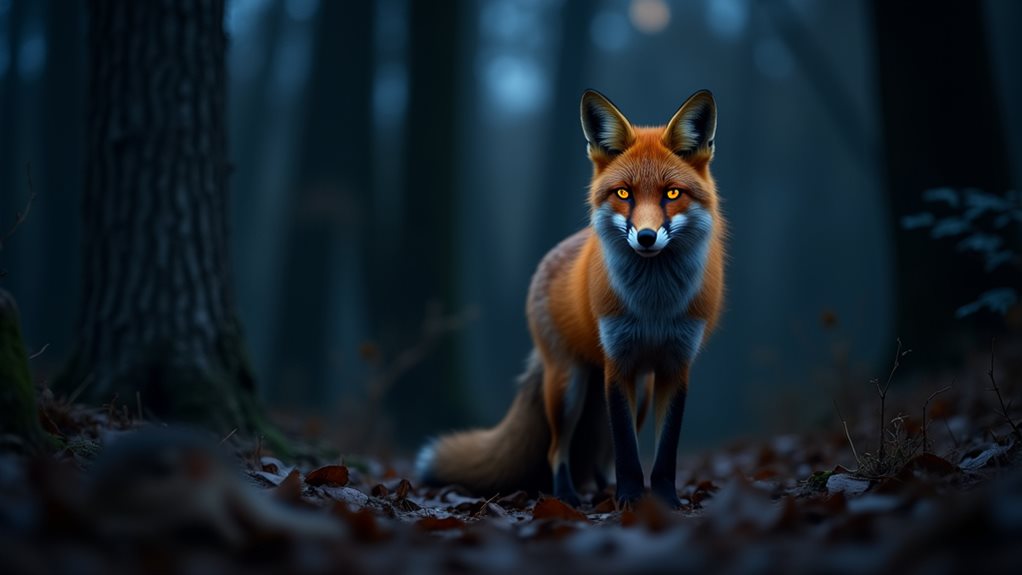
While the tapetum lucidum gives foxes their distinctive eyeshine, the differences between fox and human vision in darkness go far beyond this reflective layer.
If you’ve ever stumbled around your backyard at night, you’ve experienced the limitations of human sight—we simply can’t gather enough light in darkness.
Foxes, however, crush us in visual acuity comparison tests under low light conditions. Their eyes contain a higher percentage of rod cells, which detect movement and work in dim conditions.
Light sensitivity differences are striking—foxes can see clearly in light levels about five times dimmer than what you need to find your way safely. While you might need a flashlight to spot that garden hose, a fox is already charting its hunting route with ease, tracking tiny movements across the scenery. Additionally, the diverse diet of red foxes helps them adapt to varying environments, showcasing their survival skills and resourcefulness in harsh weather conditions.
Hunting by Moonlight: How Foxes Track Prey After Dark
As the moon casts its silvery glow across the scenery, foxes transform into nature’s most efficient nocturnal hunters.
You’ll find these crafty predators excel at moonlit hunting, using their keen senses to traverse the darkness. When you’re watching foxes, you’ll notice they don’t rely solely on vision—they’re multisensory masters.
During their nighttime adventures, foxes showcase incredible prey tracking abilities:
- They can hear mice moving under snow from up to 40 yards away.
- They’ll tilt their heads to triangulate sound with remarkable precision.
- They use their whiskers to sense prey movements in complete darkness.
In addition to their acute hearing and tactile abilities, their remarkable sense of smell aids in locating prey, even in challenging conditions. You’d be amazed at how these adaptable hunters combine their senses to create a complete picture of their surroundings, turning the challenges of darkness into hunting advantages.
Vertical Pupils: Nature’s Light Adjustment Mechanism
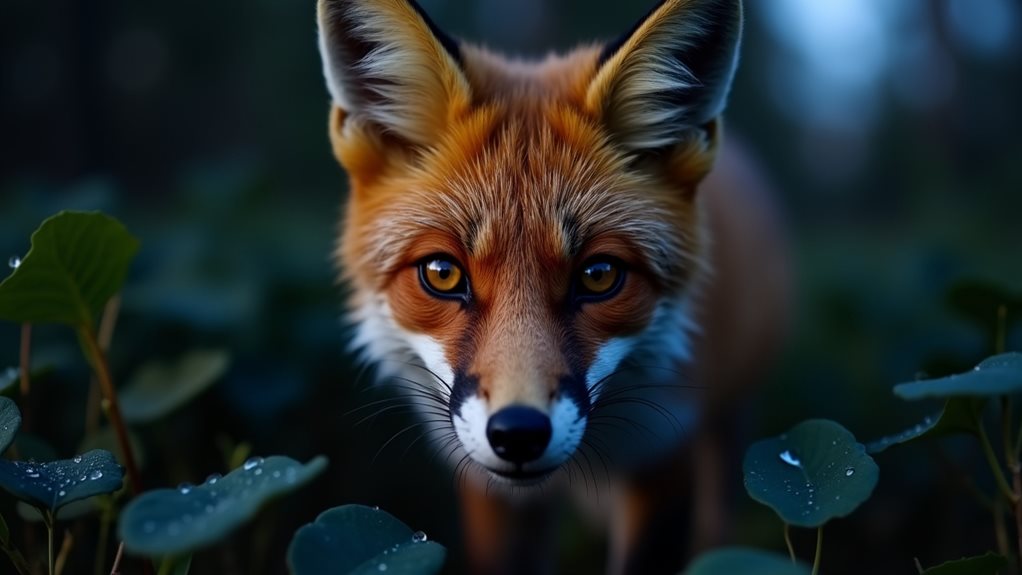
Unlike many nocturnal animals, foxes don’t actually possess vertical pupils for night vision. Instead, they’ve horizontally elongated pupils that function differently from the cat-like vertical slits you might expect. This unique pupil shape helps foxes maintain a wide field of view while still allowing effective light regulation in varying conditions.
When you’re watching foxes at dusk, you’ll notice they don’t need to squint like we do. Their specialized pupils automatically adjust to changing light levels, letting in just the right amount of illumination without overwhelming their sensitive retinas. This adaptation perfectly suits their crepuscular lifestyle—being most active at dawn and dusk.
This horizontal pupil design gives foxes an advantage when scanning open terrain for prey or predators, balancing their need for detail with their requirement for detecting movement across a broad vista.
Color Perception: What the World Looks Like to Nocturnal Foxes
Unlike your full-color perception, a fox sees the world through dichromatic vision, distinguishing primarily blues and yellows rather than the complete rainbow you enjoy.
This limited color system, while restricting their daytime palette, actually helps foxes excel in low-light conditions where color perception naturally diminishes for all creatures.
You’d find their night vision fascinating—they sacrifice color diversity for improved brightness detection, making them perfectly adapted to hunting in the dark hours when their prey is most vulnerable.
Dichromatic Color System
The world through a fox’s eyes isn’t quite the rainbow of colors you might imagine. Foxes have dichromatic vision, meaning they only see two primary colors, unlike your human eyes that detect three. This limited color perception helps them improve in low-light conditions when hunting prey.
Imagine viewing everything through a filter that emphasizes blues and yellows while muting reds and greens. That’s how foxes experience their surroundings!
- Foxes can distinguish between blues and yellows quite well, helping them spot prey against various backgrounds.
- Their dichromatic vision boosts contrast in dim light, giving them an edge during dawn and dusk hunts.
- While they miss out on the full color spectrum, their specialized vision provides advantages for their nocturnal lifestyle.
Night Color Limitations
During nighttime, a fox’s color perception shifts dramatically from its already limited dichromatic system. You might wonder what the world looks like through a fox’s eyes when darkness falls—it’s quite different from your experience!
While these clever creatures excel at detecting movement in low light, their color perception becomes nearly nonexistent. The visual limitations foxes face at night mean they rely primarily on shades of gray, with almost no ability to distinguish between colors.
It’s like watching an old black-and-white movie, but with the volume turned up on contrast and motion detection.
This trade-off serves them well, though. What foxes sacrifice in color vision, they gain in sensitivity to light and movement—exactly what a nocturnal hunter needs to catch that midnight snack!
Beyond Vision: How Foxes Combine Senses for Night Hunting
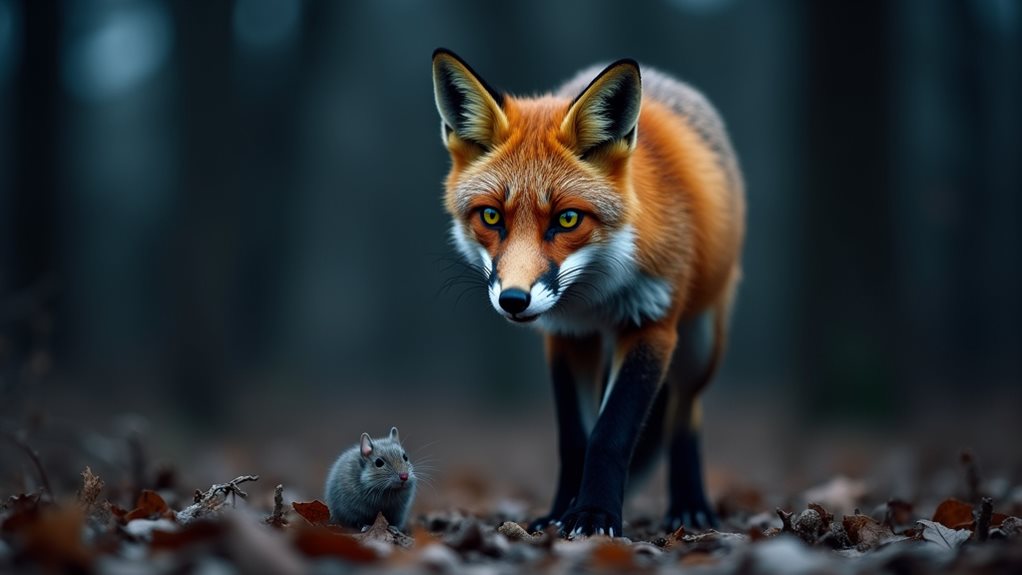
Hunting under the veil of darkness requires more than just exceptional eyesight, which is why foxes have developed an impressive arsenal of sensory tools to become master night predators.
Nature’s silent assassins, foxes navigate darkness with senses that outperform our wildest technological dreams.
While you might think vision leads the charge, it’s actually their remarkable scent tracking and auditory perception that often guide these clever hunters to success.
- Their nose can detect prey hiding underground or beneath snow, picking up scents you’d never notice.
- Their ears rotate independently, catching the slightest rustle of a mouse up to 100 feet away.
- Their whiskers and facial hairs work like night-time navigational tools, helping them avoid obstacles in pitch darkness.
You’d be amazed at how these senses work together, creating a 3D map of their surroundings that’s far more detailed than what vision alone could provide. Additionally, their ability to communicate through vocalizations and body language plays a crucial role in coordinating hunts with other pack members.
Evolutionary Adaptations: Why Fox Vision Developed This Way
This remarkable sensory teamwork didn’t develop by chance—it’s the product of millions of years of evolutionary refinement.
Foxes evolved under intense evolutionary pressures that shaped their sensory systems to perfectly match their lifestyle. You might wonder why they didn’t merely develop perfect night vision like some other nocturnal creatures. The answer lies in their unique ecological niches.
Unlike strictly nocturnal animals, foxes are crepuscular—most active during dawn and dusk. They needed vision that could adapt to changing light conditions, not only darkness. This flexibility allowed them to exploit food resources throughout different times of day.
It’s like nature designed a Swiss Army knife instead of a specialized tool! Their eyes strike a perfect balance between day and night vision, giving them the versatility to thrive in diverse environments. Their adaptations, such as keen senses of smell and hearing, further enhance their ability to hunt effectively even in low-light conditions.
The Limits of Fox Night Vision: When Even Their Eyes Can’t See
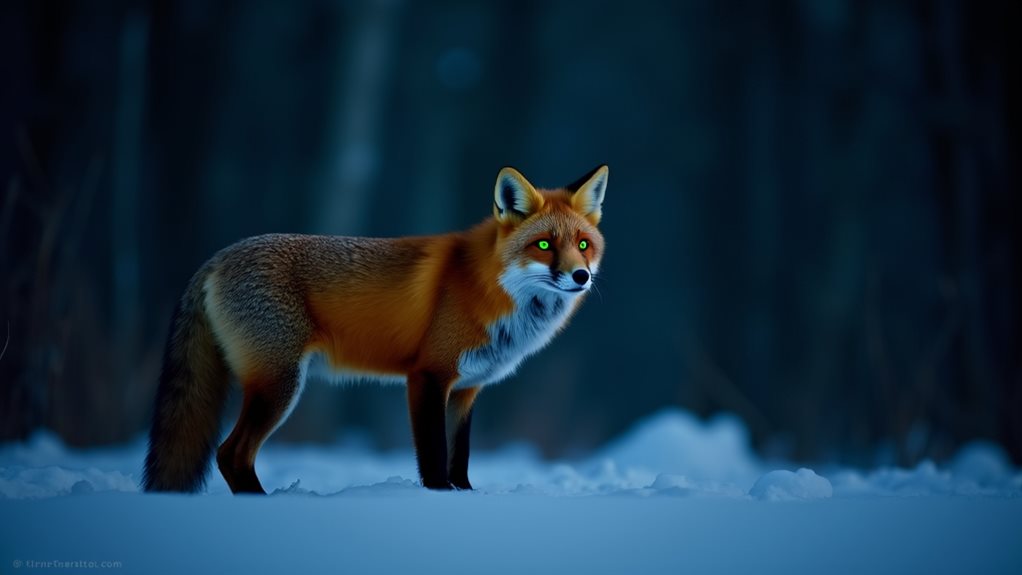
While foxes possess remarkable night vision capabilities, their visual perception does have considerable limitations in extreme darkness. You’ll find that on moonless nights or in dense forests, fox vision isn’t quite as superheroic as you might think. Even these nocturnal hunters struggle when light levels drop below certain thresholds.
When vision fails, foxes must rely on their other impressive senses:
- Their acute hearing detects the faintest rustles of prey, compensating for visual limitations.
- Their sensitive whiskers help maneuver through pitch-black environments.
- Their keen sense of smell guides hunting strategies when eyes can’t do the job.
In addition, their aggressive behavior can sometimes be triggered by food scarcity during particularly dark nights, making them more cautious as they adjust their hunting tactics.
You might notice foxes becoming more cautious during the darkest nights, adjusting their hunting strategies to work with, not against, these visual constraints.
They’re adaptable creatures, making the most of whatever senses serve them best in challenging conditions.
Final Thoughts
You might think foxes see a completely different world at night, but they’re experiencing the same moonlit scenery you do—just with incredible clarity. Their specialized eyes aren’t supernatural; they’re brilliant evolutionary solutions to survival challenges. Next time you spot those glowing eyes in your yard, you’re witnessing nature’s night vision technology in action. These remarkable adaptations remind us that sometimes, the most magical abilities come from practical natural design.