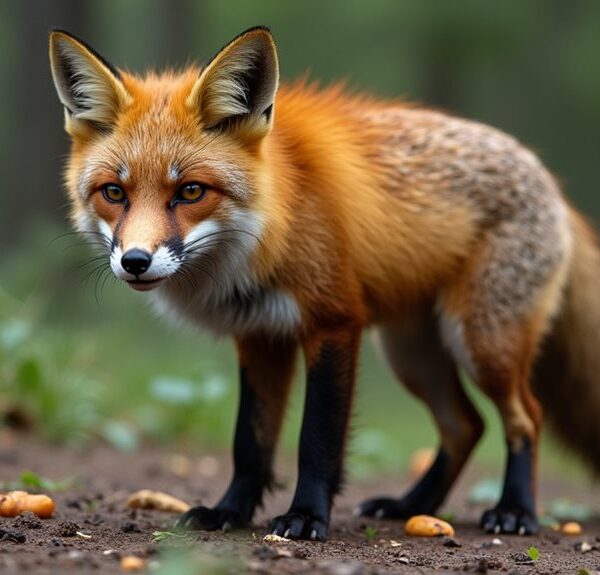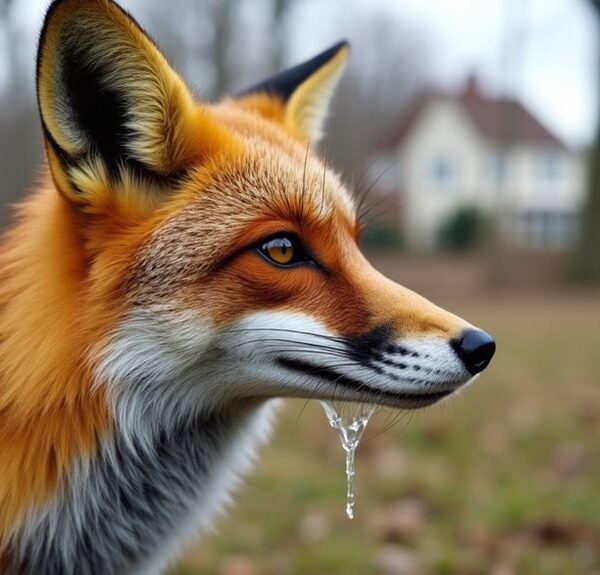

Fox hunting behavior is both strategic and instinctive. While their famous “mousing leap” is hardwired in their DNA, foxes display remarkable problem-solving abilities too. You’ll notice they adapt their hunting techniques to different environments—using shadows in cities and tall grass in fields. Their exceptional senses (hearing 400 times better than humans) work alongside learned behaviors. Young foxes develop skills through play and maternal guidance, combining innate abilities with experience-based strategies. Discover how these clever predators balance programming with adaptability.
The Distinctive “Mousing Leap”: Precision or Programmed Response?

How does a fox capture its prey with such stunning precision? You’ve likely seen videos of the famous mousing leap, where a fox pounces high into the air before diving headfirst into snow to catch hidden rodents. This remarkable hunting technique isn’t learned behavior—it’s completely instinctual.
Foxes don’t learn to hunt—their DNA programs the perfect pounce, an evolutionary masterpiece of precision.
When you watch a fox hunt, you’re witnessing millions of years of evolution in action. Their ears can detect the faintest rustling beneath snow or leaves, and they’ll tilt their heads to triangulate the exact position of their prey.
The high jump isn’t just for show—it gives them the perfect angle to strike through even thick snow cover. Isn’t it fascinating that this complex sequence of movements comes pre-programmed in their DNA? This instinctual behavior showcases their hunting techniques in the tundra, which have been fine-tuned for survival.
You’re observing pure instinctual behavior that’s been refined through countless generations.

Tracking and Stalking Techniques in Different Environments
While the mousing leap showcases the fox’s instinctual hunting prowess, these cunning predators adapt their tracking and stalking methods to suit various terrains.
You’ll notice their urban adaptability when they silently traverse city parks and suburban yards, using shadows and structures to mask their approach. They’ve learned to time their movements with traffic noise to cover the sound of their footsteps!
In rural challenges, foxes employ different tactics. They’ll use tall grass as cover, freezing in place when prey looks up, then inching forward when attention drifts.
You’ve probably never spotted a stalking fox in a field—that’s how good they are! Their sensitive whiskers and keen hearing help them track mice beneath snow, while their remarkable sense of smell allows them to follow scent trails for miles across changing environments. Understanding their social behaviors can also enhance our appreciation of their hunting methods.
The Role of Sensory Adaptations in Hunting Success

Their uniquely adapted ears can rotate independently to pinpoint the faintest sounds of prey moving beneath snow or rustling in grass. These clever predators also rely on an exceptional sense of smell that’s 400 times more powerful than ours, combined with sharp vision that excels at detecting even the slightest movements in dim light or across open terrain. Additionally, their larger nasal cavity enhances scent detection, allowing them to locate prey even in challenging conditions.
Acute Hearing Advantages
Foxes possess extraordinary hearing capabilities that transform them into formidable predators in the wild.
You’ve probably noticed how their distinctive ears rotate independently, allowing them to pinpoint the exact location of prey hidden beneath snow or vegetation. This acute hearing gives foxes an edge when hunting in complete darkness, as they can detect the subtle rustle of a mouse from over 40 yards away!
Their heightened environmental awareness isn’t just about catching dinner. It’s also critical for their survival, helping them avoid predators and traverse challenging terrain.
When you watch a fox tilt its head to the side, it’s actually triangulating sound with incredible precision. Isn’t it fascinating how nature has equipped these clever hunters with such specialized tools? Their auditory adaptations represent millions of years of evolutionary refinement, complementing their visual capabilities, such as high rod density which enhances their low-light vision.
Scent Detection Capabilities
A remarkable nose serves as the fox’s most powerful hunting tool, rivaling even its impressive hearing abilities.
You’ll be amazed to learn that a fox’s nose contains millions of specialized olfactory receptors, allowing them to detect prey hiding beneath a foot of snow or soil.
When you’re watching a fox pause and tilt its head, it’s actually processing complex scent information, comparing it to its extensive scent memory.
Unlike humans who rely primarily on sight, foxes live in a world dominated by smells.
They’ll remember the unique scent signature of successful hunting grounds for months, returning when conditions are similar.
Their nostrils can independently detect directional scent information, creating a 3D “smell map” of their surroundings.
It’s like having a superpower you can’t see but that keeps their bellies full!
Additionally, their exceptional scent detection capabilities are greatly enhanced by their unique foot structure, which improves their stealth during hunting.
Visual Tracking Mechanisms
While scent detection remains their primary advantage, the visual capabilities of foxes contribute greatly to their hunting prowess.
You’ll notice that their visual perception has evolved specifically for hunting success, allowing them to spot the slightest movements in dense vegetation or snow.
When tracking prey, foxes rely on three key visual adaptations:
- Improved night vision with reflective eye layers that amplify available light
- Motion detection sensitivity that identifies prey movement from up to 50 yards away
- Color perception optimized for dawn and dusk hunting conditions
Their remarkable tracking accuracy comes from integrating what they see with what they smell.
You’ve probably noticed how foxes tilt their heads when hunting—they’re triangulating visual information!
Additionally, their keen hunting skills are essential for locating prey like lemmings, which are impacted by changing vegetation growth patterns. This combination of keen eyesight and calculated movements makes them such effective hunters, even when scent trails grow faint.
Learning Curves: How Young Foxes Develop Hunting Skills

You’ll notice that young foxes aren’t born hunters but develop their skills through countless hours of practice and play. As kits pounce on leaves, stalk insects, and practice their stealth, they’re actually honing essential skills they’ll need for survival. Mother foxes play an important role in this education, demonstrating proper techniques and gradually introducing their young to live prey, guaranteeing they’ll eventually master the art of the hunt. Early social interactions set the foundation for future hierarchies, influencing how quickly young foxes learn to hunt effectively.
Practice Makes Perfect
Pouncing, stalking, and chasing become second nature for young foxes only after months of persistent practice.
You’ll notice that fox kits engage in daily practice sessions with their siblings, improving their techniques through playful competition. This skill improvement happens through trial and error, with parents occasionally demonstrating proper form.
What makes these practice sessions so effective? It’s all about repetition:
- Morning sessions focus on basic pouncing techniques
- Afternoon practice boosts stalking precision
- Evening games develop endurance for long chases
You’re watching nature’s training program in action when you observe these furry youngsters at play. Their mock battles aren’t just cute antics—they’re crucial rehearsals for survival. These playful interactions also promote cooperative breeding dynamics, ensuring that kits learn essential skills for their future.
Mother Knows Best
Mother foxes stand at the center of their kits’ hunting education, serving as both teacher and role model throughout the learning process.
You’ll notice how a vixen’s maternal guidance shapes her young ones’ development from their first wobbly steps to becoming skilled hunters.
When you observe fox families, you’ll see that instinctual learning happens through careful demonstration. The mother will bring live prey back to the den, showing her kits how to pounce and deliver the killing bite.
She’ll deliberately slow her movements, making complex techniques visible to her attentive audience.
As kits grow, the mother gradually increases the challenge, eventually taking them on hunting expeditions where they can practice under her watchful eye.
This perfect balance of instruction and independence guarantees survival skills pass seamlessly from one generation to the next. Additionally, the presence of a dominant social structure in the group plays a crucial role in fostering a competitive and adaptive learning environment for the young foxes.
Adaptability Across Urban, Rural, and Wilderness Settings
Unlike many predators with rigid hunting patterns, foxes demonstrate remarkable adaptability in their hunting strategies across vastly different environments.
You’ll notice their urban adaptability when watching them maneuver through city terrains with ease, snatching food from garbage bins or hunting small rodents in parks.
In rural strategies, they blend traditional hunting with opportunistic scavenging.
Foxes adjust their hunting techniques based on their surroundings in three main ways:
Foxes thrive by transforming their hunting approach to match urban, rural, or wilderness landscapes with remarkable intelligence.
- In cities, they’re more likely to hunt alone and at night, avoiding human interaction.
- Rural foxes often use classic pouncing techniques in open fields for mice and voles.
- Wilderness foxes display more traditional predatory behavior, tracking prey over longer distances.
Interestingly, urban foxes often find that about 50% of their diet consists of household waste, showcasing their clever adaptability to human-modified landscapes.
You can’t help but admire how these clever creatures adapt to whatever environment they find themselves in.
Comparing Fox Tactics to Other Canid Hunting Behaviors

When you observe foxes hunting alongside wolves, coyotes, and other canid relatives, their distinctive tactics immediately stand out.
Unlike wolves that rely on pack coordination to take down larger prey, foxes have perfected the art of solo hunting with their famous “mouse pounce.” This unique technique shows how foxes have evolved separately from their more social cousins.
You’ll notice territorial behavior differs too. While wolves defend vast territories as family units, foxes maintain smaller, individual hunting grounds.
They’re surprisingly adaptable loners! That’s not to say foxes don’t benefit from social learning – young kits watch their parents hunt, picking up critical skills through observation rather than group participation.
It’s fascinating how these clever hunters have developed such specialized methods despite sharing ancestry with pack hunters.
The Evolutionary Advantages of Flexible Hunting Methods
The evolutionary path of foxes has equipped them with remarkably flexible hunting methods that serve as their greatest survival advantage.
You’ll notice their hunting adaptability changes with seasons, terrain, and available food sources, setting them apart from more specialized predators.
Their prey selection reflects this incredible versatility. You might see a fox hunting in three distinct ways:
- Pouncing with precision on mice beneath snow using magnetic field detection
- Stalking birds with cat-like stealth, freezing mid-stride when necessary
- Chasing rabbits in zigzag patterns, anticipating escape routes through memorized territory
When you watch foxes hunt, you’re witnessing millions of years of evolutionary refinement.
They’ve developed this flexibility not by chance, but through the relentless pressure of survival, allowing them to thrive where more specialized hunters might starve.
Case Studies: Notable Observations of Fox Problem-Solving

While researchers have long suspected foxes possess exceptional problem-solving abilities, several documented case studies now provide compelling evidence of their remarkable intelligence.
You’ll find that foxes display impressive cognitive flexibility when faced with challenges in their natural habitats. In urban environments, they’ve been observed using traffic patterns to safely cross busy streets and developing techniques to access seemingly fox-proof garbage containers.
Environmental influences clearly shape their adaptive behaviors. In one fascinating study, Arctic foxes demonstrated the ability to track fish beneath ice by detecting subtle vibrations, a skill developed specifically for their harsh habitat.
Another case documented a red fox creating a fishing tool from discarded human materials, showing not only problem-solving but potential tool use—something previously attributed to only a few mammal species.
The Broader Implications for Understanding Predator Cognition
As researchers continue to document sophisticated fox behaviors, you’ll find their discoveries revolutionizing our understanding of predator cognition across species.
Foxes demonstrate remarkable cognitive flexibility when hunting, adapting their strategies based on environmental changes and prey selection opportunities.
What does this mean for science? It challenges traditional views of instinct-driven predators in three notable ways:
- Predators may possess higher cognitive abilities than previously believed
- Cognitive flexibility likely evolved as a survival advantage across predator species
- The line between instinct and learned behavior appears more blurred than distinct
You’ll appreciate how these insights impact conservation efforts and wildlife management practices.
When you understand that predators like foxes make conscious hunting decisions rather than merely following instinctual drives, you’re witnessing a fascinating window into animal intelligence that connects us all within nature’s complex web.
Final Thoughts
You’ve seen how foxes blend instinct with strategy, much like a chess player who knows the rules but improvises brilliantly in the moment. When that red fox in Finland cached over 80 mice during a single night, it wasn’t just following programming—it was planning ahead. Your takeaway? Fox hunting sits at nature’s fascinating intersection of hardwired behavior and adaptive intelligence, reminding us that the line between instinct and strategy isn’t as clear as we once thought.