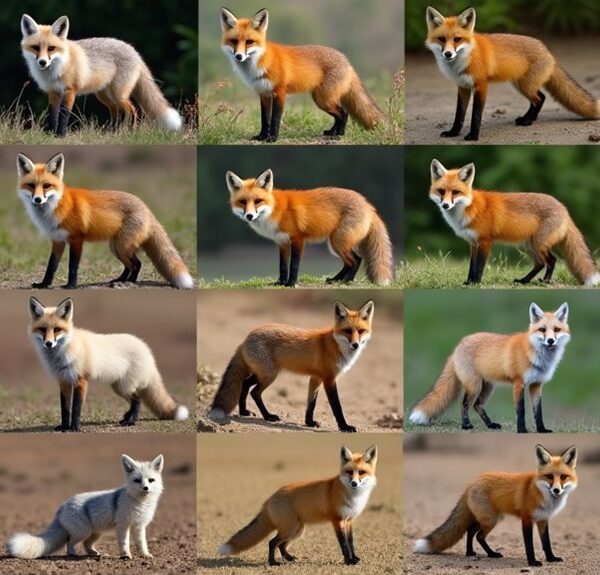
Countryside foxes differ from their urban cousins in several key ways. You’ll notice rural foxes have thicker, more vibrant reddish coats and larger bodies, while city foxes are smaller with duller fur. Country foxes hunt small mammals across territories up to 12 square kilometers, whereas urban foxes scavenge human food within half a square kilometer. Rural foxes avoid humans, but city foxes show remarkable tolerance. The fascinating adaptations don’t stop there.
Contents
- 1 Physical Appearance and Size Variations
- 2 Diet and Foraging Strategies
- 3 Territory Size and Marking Behaviors
- 4 Response to Human Presence
- 5 Denning and Shelter Preferences
- 6 Reproductive Patterns and Family Structures
- 7 Nocturnal vs. Diurnal Activity Cycles
- 8 Survival Rates and Mortality Causes
- 9 Communication and Social Interactions
- 10 Adaptations to Environmental Stressors
- 11 Final Thoughts
Physical Appearance and Size Variations
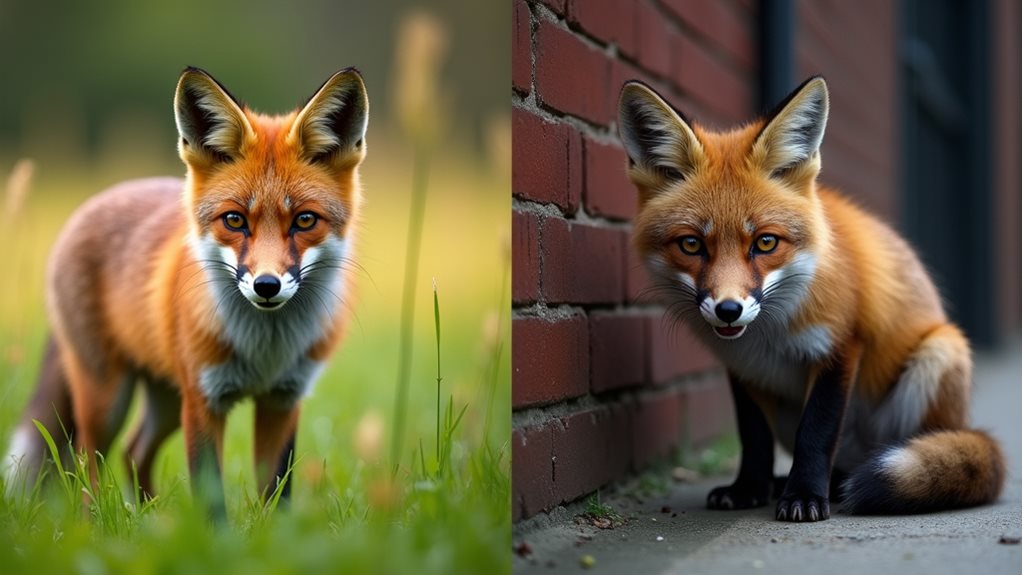
When you observe foxes in different environments, you’ll notice striking variations in their physical appearance and size.
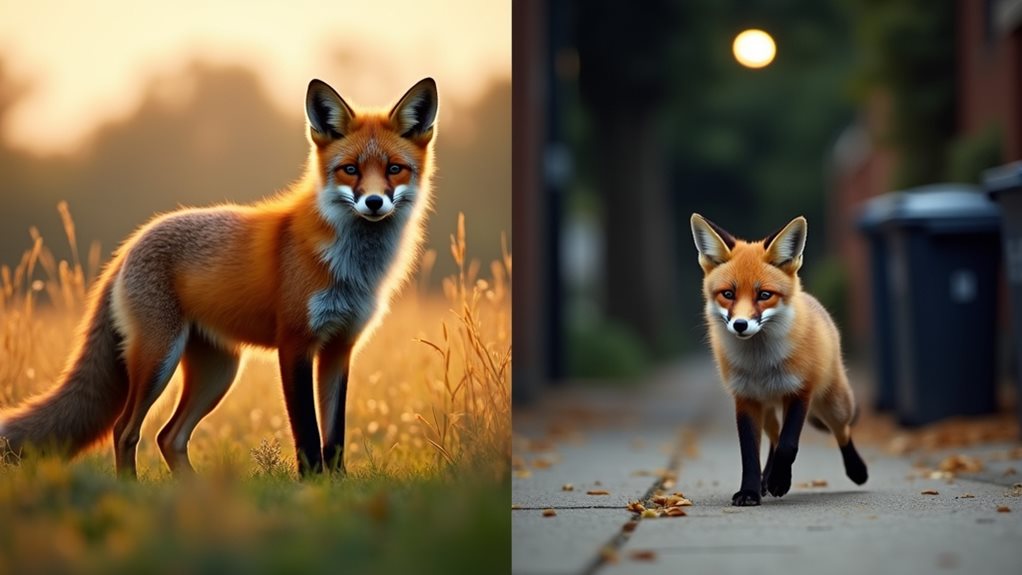
Countryside foxes typically sport thicker, more vibrant coats with rich reddish-brown hues that help them blend into natural surroundings. They’re generally larger and more robust than their city cousins, having evolved to hunt larger prey and travel greater distances.
Rural foxes showcase nature’s elegant adaptation—larger bodies and vibrant coats perfectly suited for wilderness survival.
Urban foxes, by contrast, often appear slightly smaller and leaner in a direct size comparison. Their coat color tends to be duller, sometimes with patches of gray or brown that work surprisingly well against concrete and brick backdrops.
You’ll also spot that city foxes have slightly shorter legs and bushier tails. These adaptations aren’t just coincidence—they reflect each fox’s lifestyle and the unique challenges they face in their respective environments. Furthermore, urban foxes’ smaller home ranges are a direct result of their adaptation to urban areas, allowing them to thrive in neighborhoods with plenty of vegetation.
Diet and Foraging Strategies
Four distinct feeding strategies separate countryside foxes from their urban counterparts, reflecting their remarkable adaptability to different environments.
If you’ve ever spotted a rural fox, you’ll notice they rely heavily on hunting small mammals like mice and rabbits, making up nearly 70% of their diet. Their foraging habits involve patiently stalking prey in open fields and woodlands.
Urban foxes, however, have become expert scavengers. You’ll find them rummaging through garbage bins, feasting on discarded fast food, and even accepting handouts from well-meaning residents!
Their food sources are far more diverse and unpredictable, requiring less hunting skill but more cleverness. While countryside foxes maintain traditional predatory behaviors, city-dwelling foxes have fundamentally reinvented themselves as opportunistic omnivores, adapting brilliantly to human environments. This flexibility mirrors the seasonal dietary changes exhibited by foxes in the wild, as they adjust their eating habits based on available food sources.
Isn’t nature’s flexibility amazing?
Territory Size and Marking Behaviors
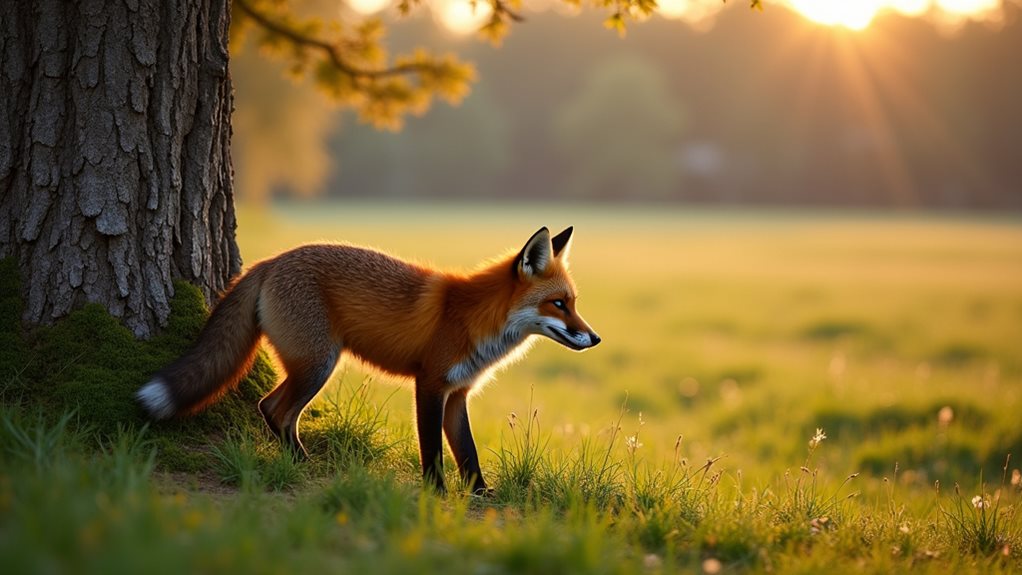
You’ll notice striking differences in territory size between countryside foxes, who roam vast areas up to 12 square kilometers, and their urban cousins who make do with just 0.5 square kilometers in cities.
When marking these territories, countryside foxes rely heavily on urine and scat placed at strategic boundary points, while urban foxes adapt by using more frequent scent marking on human-made structures like fences and garden walls.
These territorial behaviors reflect how foxes have cleverly adjusted their natural instincts to fit their environment, whether that’s the wide-open fields of rural areas or the compact neighborhoods of our bustling cities. Additionally, urban foxes exhibit increased exploration of their habitat, showcasing their adaptation strategies in urban living conditions.
Space and Range Differences
Sure! Here’s the revised content following your directions:
—
Unlike their countryside relatives who roam vast territories, urban foxes have adapted to much smaller home ranges in our cities and suburbs.
You’ll find that habitat fragmentation in cities forces these adaptable creatures to make do with less space, while countryside foxes enjoy expansive natural scenery. Urban population density pushes foxes to become masters of efficiency, utilizing every nook and cranny of available space.
Here’s how space and range truly differ between these fox populations:
- Rural foxes travel up to 5 miles nightly, while city foxes might only roam 1-2 miles.
- Urban foxes traverse complex human-dominated environments instead of open fields.
- City foxes often share territories with more overlap than their countryside cousins.
- Rural foxes maintain larger territories that shift seasonally with food availability, which is influenced by their foraging techniques in urban settings.
—
This additional sentence incorporates knowledge from the provided data effectively.
Scent-Marking Variations
While both fox populations rely on scent-marking, their approaches differ dramatically based on their environment and territory size.
You’ll notice countryside foxes maintain larger territories, often spreading their scent glands’ secretions across several miles. They’ll mark boundary lines less frequently but more strategically, focusing on trail intersections and prominent geographical features. Their territory marking needs to cover extensive areas efficiently.
Urban foxes, however, adapt to tighter quarters with fascinating precision. They mark more intensively, using their scent glands to create denser “scent networks” throughout smaller territories.
You might spot urban foxes revisiting specific marking spots daily—street corners, garden gates, or fence posts—establishing clear boundaries in crowded neighborhoods. This concentrated territory marking helps them maneuver through complex human environments while communicating with neighboring fox families through invisible but powerful chemical messages. Additionally, the adaptability of urban foxes to human-dominated landscapes, evidenced by a population increase from 33,000 in 1995 to 150,000 in 2017, highlights their successful urban adaptation.
Response to Human Presence
As foxes have adapted to different environments, their responses to human presence have evolved in fascinating ways.
You’ll notice countryside foxes exhibit cautious behavioral adaptations, typically fleeing when they spot you from hundreds of yards away. Urban foxes, however, display remarkable human tolerance, often continuing their activities even as you walk by.
- When a countryside fox spots you, it’ll freeze, assess the threat, then disappear into the vegetation in seconds.
- Urban foxes might boldly approach outdoor diners, waiting for fallen scraps!
- Rural foxes maintain a fight-or-flight distance of about 100+ yards, while city foxes may come within 10 feet.
- You’ll find countryside foxes are primarily nocturnal to avoid humans, but urban foxes frequently appear during daylight hours. Their unique adaptability allows them to thrive in urban environments, taking advantage of food sources and shelter opportunities.
Denning and Shelter Preferences
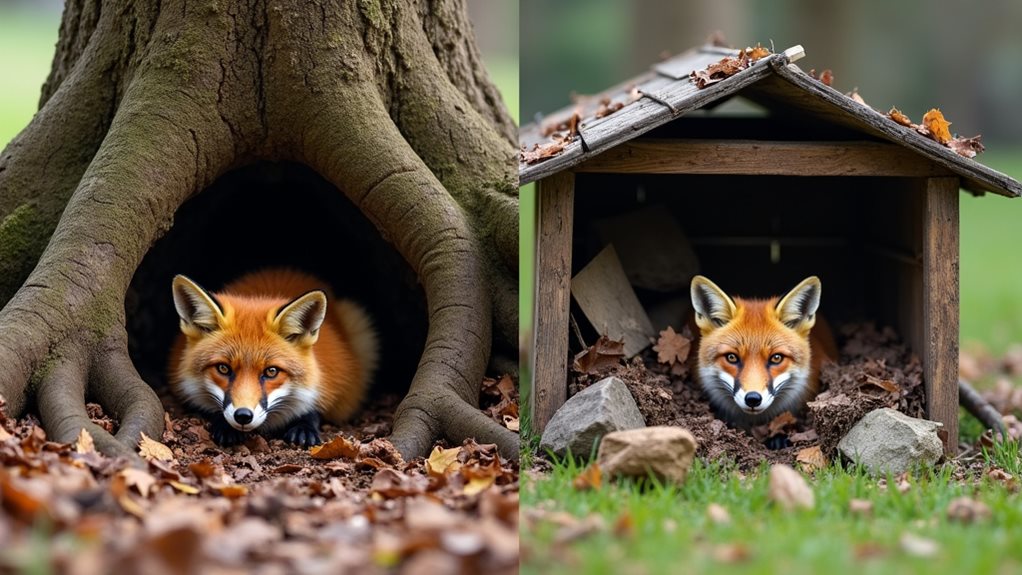
When you compare urban and countryside foxes, you’ll notice fascinating differences in their shelter choices, with city dwellers often making homes under sheds or in abandoned structures while their rural cousins prefer natural burrows.
You might be surprised to learn that urban foxes show remarkable adaptability, sometimes denning closer to human activity than you’d expect, provided they find adequate cover and protection.
Whether tucked away in a wooded area at the edge of farmland or nestled between buildings in a city block, foxes carefully select den locations that offer protection from predators, shelter from harsh weather, and proximity to food sources. Urban foxes may even use well-drained, gravelly soil for denning to ensure stability and safety.
Natural vs. Artificial Refuges
Here’s how these clever creatures find shelter:
- Countryside foxes dig elaborate burrows beneath tree roots, creating hidden sanctuaries away from predators.
- Urban foxes repurpose spaces beneath garden sheds, treating your backyard as prime real estate.
- Rural foxes often reuse abandoned badger setts, saving valuable energy through nature’s recycling program.
- City foxes squeeze into narrow spaces between buildings, turning architectural oversights into cozy apartments.
Interestingly, urban foxes thrive in cities, showcasing their remarkable adaptability to human environments.
You’d be amazed at how these adaptable animals transform whatever environment they inhabit into a perfect home.
Den Location Strategies
Fox families choose their den locations with surprising strategic intention, revealing intelligence that goes far beyond mere animal instinct. You’ll notice countryside foxes prefer natural settings for their dens, often digging elaborate burrows beneath tree roots or in hillsides, while their urban cousins adapt by utilizing spaces beneath sheds, decks, or abandoned structures. Their den construction techniques vary dramatically based on environment. Rural foxes create extensive tunnel systems with multiple escape routes, while city foxes make do with smaller, more concealed spaces. Their seasonal denning habits also differ—countryside foxes might rotate between several dens throughout the year, while urban foxes tend to stay put once they’ve found a safe location. This adaptability in denning strategy is one of the key reasons these clever creatures thrive in such diverse habitats. Additionally, urban green spaces provide essential cover for foxes, contributing to their successful adaptation in city environments.
Reproductive Patterns and Family Structures
Despite living in contrasting environments, urban and countryside foxes share fascinating reproductive patterns that adapt to their surroundings.
You’ll notice their breeding seasons typically align in both habitats, peaking in winter with cubs born in spring. However, their family dynamics reveal key differences in how they raise their young.
Nature’s calendar remains consistent—foxes everywhere mate in winter and welcome spring cubs, though urban and rural parents raise their families quite differently.
- Urban fox families often maintain smaller territories, leading to closer-knit family units that you might spot more frequently.
- Countryside foxes typically establish larger family ranges, spreading their resources across expansive areas.
- You’ll find urban vixens sometimes share den-raising duties, an adaptation to city living.
- In rural areas, foxes maintain more traditional family structures with less cooperative breeding.
These adaptations showcase how remarkably flexible fox families are, adjusting their reproductive strategies to thrive wherever they settle. Additionally, their adaptability reflects the importance of cooperative breeding dynamics, allowing them to make the most of the available resources in their specific environments.
Nocturnal vs. Diurnal Activity Cycles
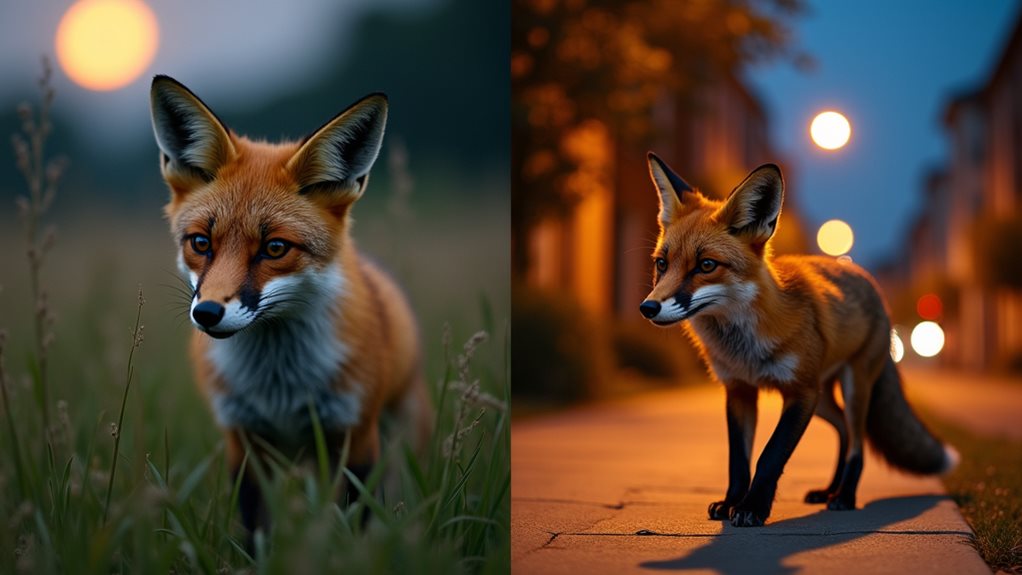
While many assume all foxes operate under cover of darkness, activity patterns between urban and countryside foxes reveal surprising adaptations to their distinct environments.
In rural settings, you’ll find foxes maintaining their natural nocturnal behavior, hunting under moonlight when prey is active and human interference minimal.
Urban foxes, however, have flipped the script! They’ve gradually shifted toward more diurnal activity, especially in areas with less human traffic.
You might spot city foxes trotting around during daylight hours, particularly at dawn and dusk. This clever adaptation helps them avoid nighttime noise, traffic, and other urban disturbances that countryside foxes never encounter.
They’ve fundamentally traded their traditional schedules for times when cities offer safer foraging opportunities—a remarkable example of how wildlife adjusts to human-dominated environments.
Survival Rates and Mortality Causes
When comparing the lifespan lottery between urban and countryside foxes, you’ll discover some striking differences in both how long they typically live and what ultimately ends their expedition.
Urban foxes have adapted unique survival strategies, often living 2-3 years longer than their rural cousins due to consistent food availability, despite higher disease prevalence in crowded city environments.
- Road accidents claim nearly 60% of urban fox lives, a heartbreaking end for creatures who never evolved to understand traffic.
- Hunting and predation accounts for most countryside fox deaths.
- Mange and distemper affect both populations, but spread faster in urban settings.
- Poisoning threatens urban foxes more frequently, often unintentionally through rodenticides.
You’ll find countryside foxes develop stronger immune responses, while city dwellers master opportunistic survival techniques.
Communication and Social Interactions

As you observe foxes interacting in their natural habitats, you’ll notice fascinating differences in how urban and countryside foxes communicate with each other.
Urban foxes have adapted their vocal communication to be less conspicuous, often using quieter calls to avoid human attention, while their rural cousins rely on louder, more traditional barks and screams to communicate across wider territories.
Social hierarchies differ too.
Countryside foxes typically maintain more traditional family groups with clearer dominance structures.
City dwellers, however, have developed more flexible social arrangements, sometimes forming larger, looser groups when resources are abundant.
You’ll find urban foxes are generally more tolerant of neighbors than their countryside relatives, who vigorously defend their territories.
These adaptations show how resourceful these animals are, adjusting their social behaviors to thrive in very different environments.
Adaptations to Environmental Stressors
You’ll notice urban foxes have developed remarkable adaptations to city life, including greater tolerance for artificial light and traffic noise compared to their countryside cousins.
When threatened, these clever creatures employ different strategies based on their environment – rural foxes might retreat to underground dens, while city dwellers use man-made structures and shadows for protection.
Their digestive systems have also evolved, with urban foxes possessing specialized gut bacteria that help them process human food waste, while rural foxes maintain enzymes better suited for breaking down wild prey and foraged plants.
Noise and Light Tolerance
Urban foxes have developed remarkable tolerance to the constant barrage of city noise and artificial lighting that would send their countryside cousins fleeing in panic.
You’ll notice these clever creatures have completely transformed their countryside behaviors into savvy urban adaptations, letting them thrive where their rural relatives couldn’t manage a single night’s rest.
Here’s how urban and countryside foxes differ in their sensory responses:
- Urban foxes can sleep through sirens and traffic noise, while countryside foxes startle at the snap of a distant twig.
- City foxes hunt confidently under streetlights, whereas rural foxes prefer moonlight only.
- Urban foxes ignore loud conversations of passing humans, unlike their shy country relatives.
- City-dwelling foxes have adapted to use artificial light for hunting advantage.
Predator Avoidance Strategies
The sensory adaptations that help foxes traverse urban soundscapes also play a key role in their strategies for avoiding danger.
You’ll notice countryside foxes rely heavily on natural cover and distance as their primary predator evasion techniques, maintaining large territories where they can spot threats early and retreat into dense vegetation.
Urban foxes, however, have developed fascinating alternatives. They’ve learned that humans aren’t always threats, allowing them closer proximity than their rural cousins would ever tolerate.
Their habitat selection differences are striking – city foxes often choose locations near human activity where larger predators rarely venture. They’ll use man-made structures like garden sheds, abandoned buildings, and even spaces beneath decks as secure denning sites.
Unlike their countryside relatives, urban foxes have also adapted to use traffic patterns and nighttime human schedules to their advantage when moving about.
Diet Flexibility Mechanisms
While both fox populations demonstrate remarkable adaptability in feeding habits, their specific mechanisms for handling environmental stressors differ considerably.
You’ll notice countryside foxes maintain more traditional foraging adaptability, hunting small mammals and birds, while urban foxes have evolved to capitalize on human waste and handouts.
Here’s how their dietary preferences adapt under stress:
- Urban foxes develop stronger stomach acids to digest processed foods that would sicken their rural cousins.
- Countryside foxes possess more refined hunting skills, tracking prey across vast territories.
- City dwellers demonstrate remarkable problem-solving abilities to access secured garbage bins.
- Rural foxes maintain seasonal eating patterns tied to natural cycles, unlike their opportunistic urban relatives.
When food becomes scarce, both populations showcase incredible resilience, but through distinctly different survival strategies.
Final Thoughts
You’ve now seen how urban and countryside foxes differ in fascinating ways. Whether it’s their diet, size, or how they’ve adapted to human presence, these vulpine creatures show remarkable flexibility. Like sending a telegraph in today’s digital world, a fox’s ability to adjust to changing environments is both outdated and impressive. Next time you spot one, you’ll appreciate how they’ve customized their lifestyle to thrive in your neighborhood or the surrounding countryside.