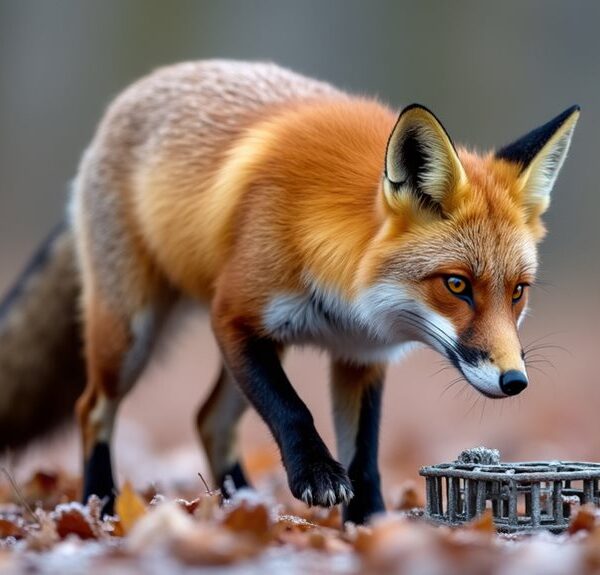
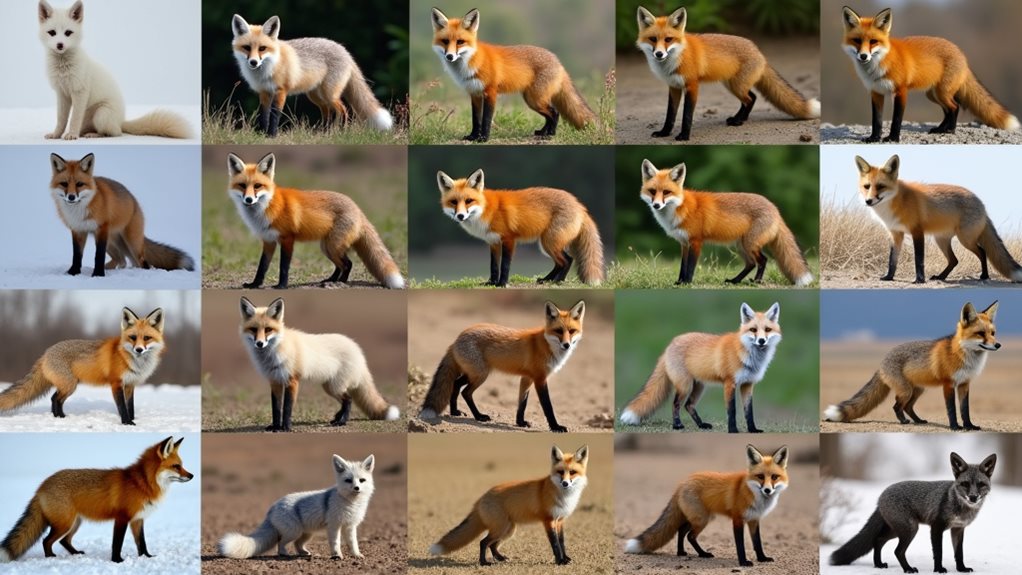
Foxes come in stunning varieties across the globe, from the familiar Red Fox to the tiny desert-dwelling Fennec with its enormous ears. You’ll find tree-climbing Gray Foxes in North America and the critically endangered Darwin’s Fox in Chile’s rainforests. Each species showcases remarkable adaptations – Arctic foxes change coat colors seasonally, while Kit Foxes thrive in scorching deserts with minimal water. These clever canids display diverse hunting strategies, social behaviors, and survival techniques unique to their environments.
Red Fox (Vulpes Vulpes)
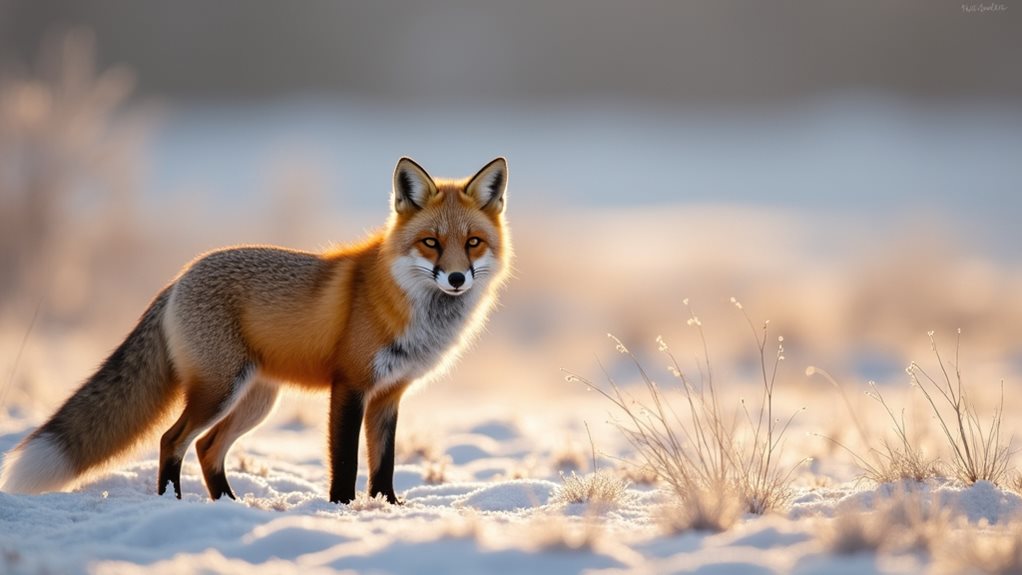
Masters of adaptation, red foxes are certainly the most recognizable fox species in the world. With their distinctive rusty-red coat, bushy tail, and pointed ears, you’ll easily spot them across North America, Europe, Asia, and even parts of North Africa.
Their remarkable red fox behavior includes being both nocturnal and crepuscular, meaning they’re most active at dawn and dusk when hunting for mice, rabbits, and birds.
Red fox habitat spans diverse environments, from forests and grasslands to mountains and suburban neighborhoods. They’re incredibly resourceful, building complex underground dens called earths where they raise their adorable kits.
You might be surprised to learn they communicate through a variety of vocalizations—including barks, screams, and howls! Their adaptability explains why they’ve thrived alongside humans while many other species struggle. Foxes have even been observed utilizing human structures for safety and food access, showcasing their urban adaptation.


Arctic Fox (Vulpes Lagopus)
Surviving in some of Earth’s harshest environments, the Arctic fox showcases nature’s incredible adaptability.
From frozen tundra to icy expanses, the Arctic fox embodies nature’s resilience in extreme conditions.
You’ll be amazed by their remarkable arctic fox adaptations – from their compact bodies to their densely furred paws that act like snowshoes! Their fur transforms seasonally, shifting from brown in summer to pristine white in winter, providing perfect camouflage year-round.
Their arctic fox diet is surprisingly versatile. These resourceful hunters primarily feast on lemmings and voles, but they’ll happily devour bird eggs, berries, and even scavenge polar bear leftovers when times get tough. Additionally, their keen senses of smell and hearing play a crucial role in locating prey hidden beneath the snow.
They’re nature’s ultimate opportunists! They’ll cache extra food beneath rocks or snow, creating their own “refrigerators” for leaner months.
Isn’t it fascinating how these small creatures, weighing just 6-10 pounds, thrive in temperatures that would leave us humans shivering?
Fennec Fox (Vulpes Zerda)

You’ll be amazed by the Fennec fox, the desert’s master of survival with its compact body and sand-colored coat that reflects heat.
Its most striking feature is its enormous ears, which can grow up to 6 inches long—nearly as big as its entire body!
These remarkable ears not solely help the fox hear prey moving underground but also act as natural air conditioners, dispersing body heat and keeping this adorable creature cool in the scorching desert. Additionally, they thrive in stable sand dunes where they construct intricate burrow systems for shelter and temperature regulation.
Desert Adaptation Features
The Fennec fox has evolved remarkable adaptations that allow it to thrive in one of Earth’s harshest environments. Those massive ears aren’t just adorable—they’re crucial desert climate survival tools that dissipate heat and help the fox detect prey moving underground.
You’ll notice their cream-colored coats reflect sunlight rather than absorb it, keeping them cool during scorching days. Their compact bodies minimize surface area, while furry paws protect against burning sand.
Perhaps most impressive are their survival strategies for water conservation—they can get most moisture from their food and have specialized kidneys that minimize water loss. These adaptations, coupled with their nocturnal behavior, allow them to remain active during cooler nights, further enhancing their chances of survival.
They’ll dig burrows up to 10 feet deep to escape extreme temperatures, creating a microclimate that’s up to 30 degrees cooler than the surface. Isn’t nature’s engineering simply incredible?
Remarkable Ear Size
Champions of hearing in the fox world, fennec foxes boast the most impressive ears of any canid relative to their body size.
You’ll be amazed at how these ears function as incredible cooling systems, dispersing body heat in the scorching desert temperatures. Each ear can grow up to 6 inches long, nearly 70% of their body length!
The distinctive triangular ear shape isn’t just for show. These oversized sound catchers help fennec foxes detect prey moving underground, giving them a hunting advantage in sparse desert environments.
They can hear rodents scurrying beneath the sand from remarkable distances! If you’re ever lucky enough to spot one, you’ll notice how they constantly rotate their ears like satellite dishes, picking up the faintest sounds while looking absolutely adorable in the process. Their survival is greatly enhanced by these adaptations for extreme environments.
Kit Fox (Vulpes Macrotis)
Smaller than most of their fox relatives, kit foxes roam the arid deserts and shrublands of southwestern North America with remarkable adaptability.
You’ll notice their oversized ears aren’t just for show—they’re cooling systems that help regulate body temperature in harsh desert conditions. Kit fox behavior revolves around their nocturnal lifestyle, where they’ll hunt jackrabbits and rodents under the cover of darkness.
Their kit fox habitat includes:
- Desert scrublands where they dig complex dens with multiple escape tunnels
- Grasslands bordering agricultural areas where prey is abundant
- Semi-arid regions with sandy or loamy soils perfect for their digging abilities
You’d be surprised how these pint-sized predators, weighing just 3-6 pounds, thrive in environments where water is scarce and temperatures swing dramatically between scorching days and frigid nights.
Swift Fox (Vulpes Velox)
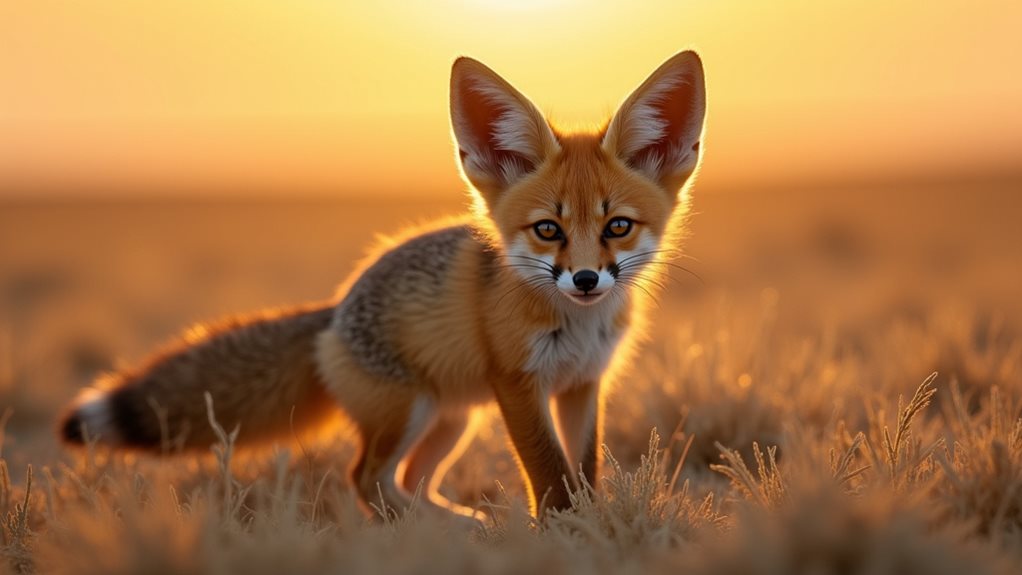
You’ll find the Swift Fox across the grasslands of North America, where it’s perfectly adapted to life on the open plains.
These small foxes, weighing just 4-6 pounds, have sandy-brown fur that blends seamlessly with their prairie habitat.
As their name suggests, they’re incredibly quick, reaching speeds up to 30 mph when they’re chasing prey or escaping predators. Their agility and speed are crucial for their survival in shortgrass and mixed-grass prairies, where they play an important role in maintaining prairie biodiversity.
Habitat and Range
The Swift Fox once roamed freely across vast stretches of the Great Plains, from southern Canada through the central United States.
Today, you’ll find these nimble creatures in a much smaller range, primarily in short-grass prairie ecosystems that offer the habitat diversity they need to thrive.
Their ecological significance can’t be overstated—they’re important indicators of healthy grassland environments.
If you’re hoping to spot a Swift Fox in the wild, look for these three key habitat features:
- Open, short-grass prairies with excellent visibility
- Sandy or well-drained soils perfect for their den-building activities
- Areas with abundant prey like rabbits, mice, and insects
You’ll rarely find them in agricultural lands, as they prefer undisturbed native grasslands where they can dash about at impressive speeds. Additionally, the kit fox’s role as a predator in their ecosystem showcases the importance of preserving these habitats for the survival of various fox species.
Physical Characteristics
Swift foxes pack incredible adaptations into their compact frames, making them perfectly suited for life on the open plains.
You’ll be amazed by their diminutive size—they’re among the smallest wild canids in North America, typically weighing just 4-7 pounds and standing about 12 inches tall at the shoulder.
Their fox coloration patterns are both beautiful and practical: a sandy-gray to yellowish-buff coat on top contrasts with their pale underside, providing perfect camouflage against prairie grasses and soil.
During winter, their fur grows thicker and slightly darker. Unlike larger fox species, these petite predators have proportionally shorter legs and tails relative to their body sizes.
Don’t let their cute appearance fool you—these adaptable creatures boast large ears that capture the faintest sounds of prey moving underground, an essential advantage for survival in their harsh environment. Swift foxes primarily hunt small mammals and insects essential for their diet, showcasing their resourcefulness.
Pale Fox (Vulpes Pallida)
Native to the semi-arid regions of Africa, pale foxes (Vulpes pallida) remain some of the most elusive members of the fox family.
You’ll rarely spot these sandy-colored canids as they’re primarily nocturnal, emerging at dusk to hunt in their arid habitat. Their pale fox behavior includes remarkable adaptations to desert living, with exceptional hearing that helps them locate prey beneath the sand.
Pale fox habitat spans across several African countries, where they’ve adapted to survive in harsh conditions with limited water. Their survival depends on three key adaptations:
- Large ears that dissipate heat and detect prey movement
- Specialized kidneys that conserve water in their dry environment
- Fur coloration that provides perfect camouflage against sandy terrains
They’re not only surviving—they’re thriving in places where few mammals dare to venture!
Rüppell’s Fox (Vulpes Rueppellii)
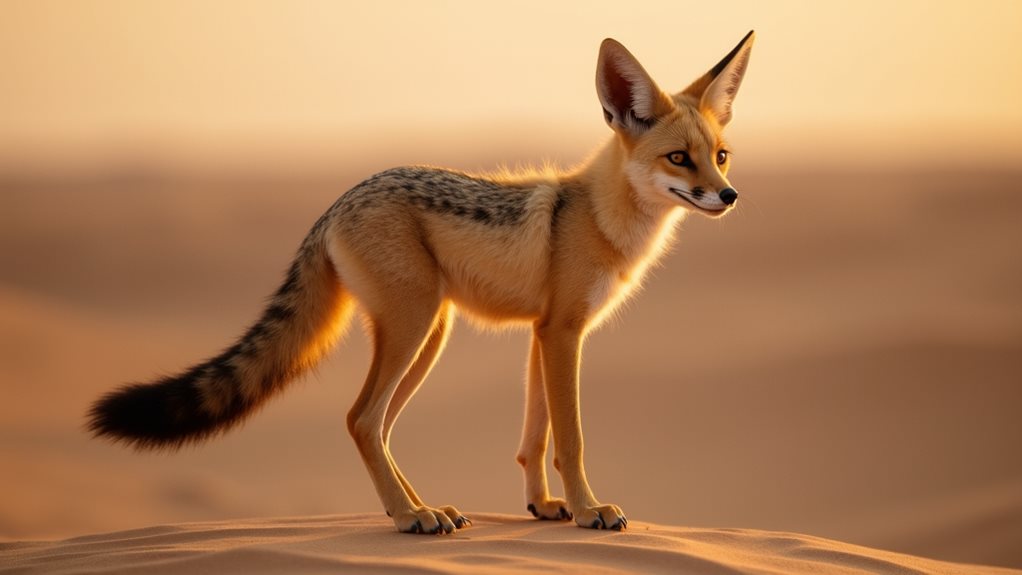
Rüppell’s fox thrives in some of Earth’s harshest deserts, thanks to its large ears that release body heat and specialized kidney function that conserves water.
You’ll notice these clever foxes often form monogamous pairs, working together to defend territories and raise their young.
Their social patterns change with the seasons, becoming more solitary during resource-scarce periods and more communal when conditions improve.
Desert Survival Adaptations
Among the most remarkable desert specialists in the fox family, the elusive Vulpes Rueppellii has evolved an impressive arsenal of adaptations to thrive in some of Earth’s harshest environments.
You’ll find these foxes have mastered desert temperature regulation through their large ears, which act as natural radiators to dissipate heat. Their nocturnal hunting strategies help them avoid the scorching daytime temperatures while conserving precious water.
These cunning survivors have developed:
- Extra-dense fur on their paw pads to protect against burning sand
- Highly efficient kidneys that require minimal water intake
- The ability to lower their metabolic rate during extreme heat waves
You’d be amazed at how these adaptations let Rüppell’s foxes flourish where other mammals simply couldn’t survive!
Social Behavior Patterns
Unlike their more solitary canid cousins, Rüppell’s foxes maintain surprisingly complex social structures that you’ll find fascinating to observe.
These desert dwellers establish clear social hierarchy systems within their family groups, typically consisting of a mated pair and their offspring. You’ll notice how they’ve developed sophisticated communication methods to survive harsh environments together.
When you watch these foxes interact, you’ll see them use vocalizations ranging from barks to whines, alongside body language that conveys important messages about food sources and potential dangers.
They’ll often groom each other to strengthen social bonds! During breeding season, their interactions become more intense as they establish territories and compete for mates.
What’s remarkable is how they balance independence with cooperation, hunting alone but sharing den sites with family members when conditions demand it.
Corsac Fox (Vulpes Corsac)
The Corsac fox roams the vast steppes and semi-deserts of Central Asia, sporting a distinctive pale yellowish-gray coat that helps it blend into its arid surroundings.
Elusive and perfectly camouflaged, the Corsac fox navigates Central Asia’s harsh landscapes with remarkable resilience.
You’ll find these adaptable creatures in the corsac fox habitat spanning from Kazakhstan to Mongolia, where they’ve evolved to thrive in extreme temperatures.
They’re primarily nocturnal and remarkably social, often living in small family groups—unlike many other fox species.
When studying corsac fox behavior, you’ll notice three fascinating traits:
- They don’t maintain permanent dens but use burrows made by other animals.
- They can go without water for extended periods, getting moisture from their prey.
- They communicate through a variety of vocalizations including barks, yelps, and growls.
Additionally, the corsac fox showcases social behavior by often hunting in groups, which enhances their effectiveness in securing food resources.
Tibetan Sand Fox (Vulpes Ferrilata)

High-altitude mountains of the Tibetan Plateau serve as home to the distinctive Tibetan sand fox, a species immediately recognizable by its square-shaped face and small, triangular ears.
You’ll find these unique foxes roaming across barren, windswept terrains at elevations of 9,800 to 17,100 feet—truly masters of their harsh Tibetan habitat!
Unlike other fox species, these solitary hunters primarily target plateau pikas, small mammals that make up about 90% of their diet.
Their Tibetan behavior includes a distinctive hunting style where they’ll patiently wait outside pika burrows, ready to pounce at the perfect moment.
They’ve adapted perfectly to the thin mountain air, sporting thick fur that protects them during freezing winters.
If you’re lucky enough to spot one, you’ll witness one of nature’s most specialized predators in action!
Blanford’s Fox (Vulpes Cana)
Hidden among the rocky mountains of the Middle East and Central Asia, Blanford’s fox remains one of the most elusive and smallest canid species you’ll encounter.
These adorable creatures have adapted perfectly to their challenging Blanford’s habitat, thriving in steep, rocky terrains where few predators can follow them. They’re primarily nocturnal, which explains why you’ll rarely spot one during daylight hours.
Blanford’s diet consists of:
- Fruits and berries, making up about 60% of their food intake
- Insects and arthropods they skillfully hunt at night
- Small vertebrates like mice and lizards when plant food is scarce
You’d be surprised by their impressive climbing abilities!
These foxes can scale nearly vertical cliffs with ease, using their semi-retractable claws and bushy tails for balance.
Bengal Fox (Vulpes Bengalensis)
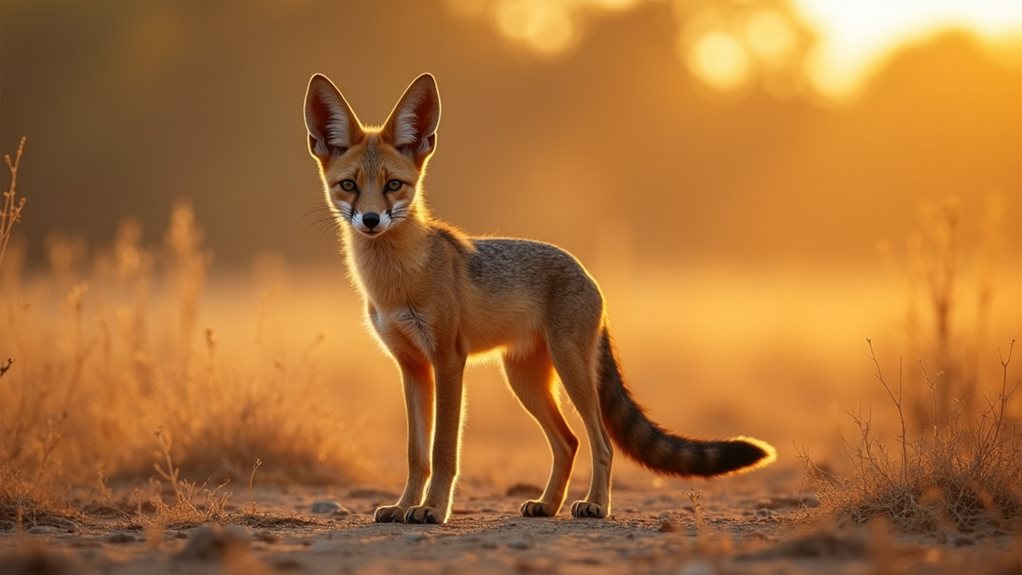
Moving from the rugged terrain of the Middle East to the arid grasslands of the Indian subcontinent, you’ll find another fascinating member of the fox family. The Bengal fox, native to the Indian peninsula, has adapted perfectly to its environment.
This smaller fox thrives in Bengal fox habitat consisting of short grasslands, scrub forests, and semi-deserts. You’d be amazed at how well they’ve adjusted to living near agricultural areas and human settlements! Their adaptability is impressive.
The Bengal fox diet is quite varied, including small mammals, birds, insects, and fruits. They’re particularly fond of hunting rodents and beetles, making them helpful for local farmers.
During monsoon season, they’ll often switch to more abundant insect populations.
If you’re lucky, you might spot these nocturnal hunters at dawn or dusk, when they’re most active!
Cape Fox (Vulpes Chama)
You’ll be fascinated by the Cape fox, a small canid found primarily in the arid regions of southern Africa, with its distinctive sandy-gray coat and large, pointed ears perfect for heat regulation and detecting prey.
These adaptable creatures are mainly nocturnal, emerging at dusk to hunt for insects, small rodents, and occasionally fruits, while spending daylight hours in their underground burrows.
Though often solitary, Cape foxes form monogamous pairs during breeding season, displaying unique social behaviors that help them thrive in harsh desert environments.
Physical Characteristics & Habitat
Native to southern Africa, the Cape fox (Vulpes chama) is a small, distinctive member of the canid family with a unique set of physical characteristics adapted for its arid habitat.
You’ll notice their silvery-gray coat with yellow undertones, which provides excellent camouflage in grasslands and semi-desert regions. Like their urban fox adaptations in other species, Cape foxes have developed keen senses to survive harsh conditions.
These foxes have mastered survival through:
- Specialized large ears that dissipate heat and detect prey movement underground
- Fox communication methods including high-pitched calls and facial expressions
- Nocturnal behavior to avoid extreme daytime temperatures
Their compact bodies (3-6 pounds) and bushy tails help them maintain balance while hunting insects, small mammals, and birds.
You’ll typically find them in abandoned aardvark burrows where they raise their young.
Behavior & Diet Patterns
Cape foxes demonstrate fascinating behavioral patterns that complement their physical adaptations for survival in harsh environments. You’ll notice their remarkable social learning capabilities, as young foxes carefully observe adults to master hunting strategies.
They’re primarily nocturnal, sleeping during hot days and becoming active at dusk when temperatures drop.
Their diet is impressively diverse—you’ll find them hunting small rodents, insects, and birds with precision and patience. They’ve developed clever hunting strategies that involve quietly stalking prey before pouncing with lightning-quick reflexes.
When food is scarce, they’ll happily munch on wild fruits and berries. Unlike some fox species, Cape foxes aren’t particularly territorial, and you might spot them sharing hunting grounds with family groups.
This adaptability has helped them thrive in their challenging habitats.
Bat-Eared Fox (Otocyon Megalotis)
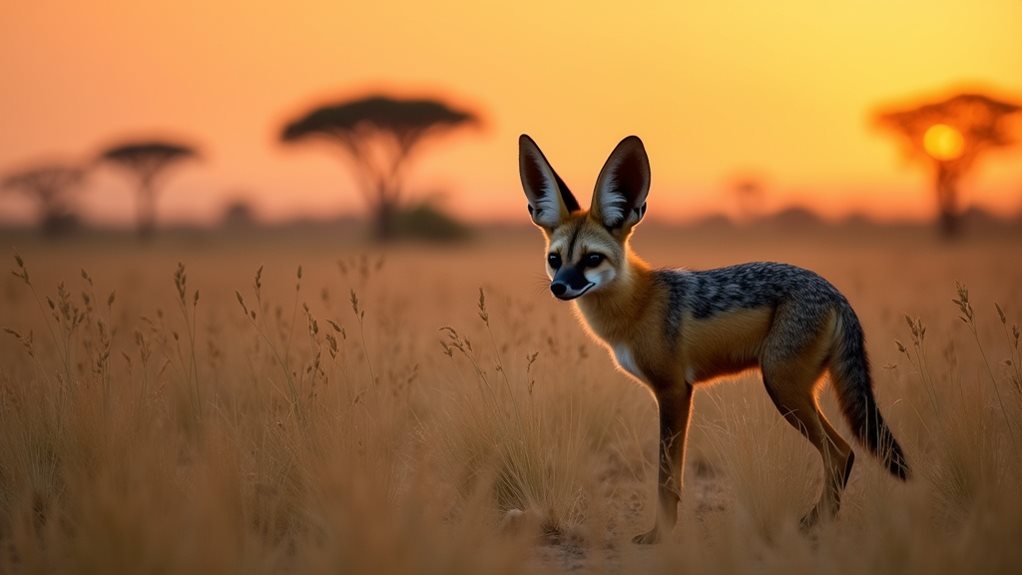
With their distinctive oversized ears, bat-eared foxes stand out as one of Africa’s most charming and unusual canid species.
With their massive satellite-dish ears, bat-eared foxes capture both insects and the hearts of safari enthusiasts.
You’ll find these adorable creatures primarily in the eastern and southern regions of Africa, where they’ve adapted perfectly to their bat eared fox habitat of open grasslands and savannas.
Unlike most foxes, their bat eared fox diet consists mainly of insects! They’re specialized termite hunters, using those massive ears to locate bugs underground. Their unique eating habits make them critical for controlling insect populations.
These social foxes typically live in small family groups where you might observe:
- Both parents participating in raising young pups
- Complex communication through ear positions and body language
- Cooperative hunting techniques where family members work together
You’ll love watching these fascinating creatures if you’re lucky enough to spot them!
Crab-Eating Fox (Cerdocyon Thous)
You’ll find crab-eating foxes across South America’s diverse terrains, from tropical forests to savannas and wetlands.
These medium-sized foxes sport grayish-brown fur with distinctive black markings along their backs and tails, reaching about 2.5 feet in length.
Despite their name, they don’t primarily eat crabs but have adapted to consume a varied diet of small mammals, birds, reptiles, fruits, and yes, occasionally crustaceans when available in their habitat.
Habitat and Range
The Crab-Eating Fox thrives across a surprisingly diverse range of habitats throughout South America, despite what its name might suggest.
You’ll find these adaptable canines in a remarkable variety of environments, showcasing their impressive habitat diversity. Their geographic distribution spans several countries including Brazil, Colombia, Venezuela, and Argentina.
These resilient creatures have made themselves at home in:
- Savannas and grasslands where they hunt small mammals
- Woodland edges and forest margins where vegetation provides cover
- Wetlands and coastal areas where they can find their famous crab meals
While they don’t mind getting their paws wet near marshes and mangroves, they’re equally comfortable in drier regions.
This adaptability has helped them maintain stable populations even as their environments change due to human development.
Physical Characteristics
Crab-eating foxes possess a striking appearance that immediately distinguishes them from other fox species you’ll encounter in South America.
These medium-sized canids typically weigh between 10-15 pounds, with males slightly larger than females. Their fur displays beautiful color variations ranging from grayish-brown to tawny, complemented by darker markings along their back and tail.
You’ll notice their bushy tails, which aren’t as long or fluffy as red foxes but still contain distinctive black tips. Their facial features include a pointed muzzle, large ears, and expressive eyes that help them maneuver nighttime hunts.
Size differences among individuals can vary based on habitat quality and food availability.
Despite their name, these adaptable foxes don’t primarily eat crabs—they’re actually omnivorous opportunists with a varied diet that changes seasonally!
Dietary Adaptations
Despite their misleading name, crab-eating foxes maintain incredibly versatile diets that adapt to whatever food sources their environment provides.
You’ll find these clever canids foraging throughout South America, where they’ve developed fascinating dietary preferences that help them thrive in diverse habitats. Their opportunistic nature makes them true survival specialists!
When studying their foraging strategies, researchers have identified three primary feeding patterns:
- Seasonal fruit consumption – they’ll devour ripe fruits during abundance periods
- Small prey hunting – they target rodents, birds, and insects with precise pouncing techniques
- Scavenging behavior – they’ll happily clean up carrion and human food waste
You’ve got to admire how these adaptable foxes adjust their menu based on availability, demonstrating remarkable intelligence in their food-finding approaches across varying ecosystems.
Darwin’s Fox (Lycalopex Fulvipes)
Named after the famous naturalist Charles Darwin, this critically endangered fox species calls the temperate rainforests of Chile home.
You’ll find these rare creatures primarily on Chiloé Island and in Nahuelbuta National Park, where Darwin’s habitat consists of dense forests with thick undergrowth. They’re quite adaptable but prefer the safety of forest canopies to open areas.
When it comes to Darwin’s diet, you might be surprised by their versatility! They’re omnivorous opportunists, feasting on small mammals, insects, berries, and fruits.
During summer months, they’ll happily munch on beetles and other insects, while winter brings a shift toward rodents and birds. Unlike their desert-dwelling cousins, they don’t need to search far for water, as their lush environment provides plenty of hydration sources.
Gray Fox (Urocyon Cinereoargenteus)

The remarkable Gray Fox stands out among North American canids as the only fox species that can climb trees! You’ll find these adaptable creatures in forests, woodlands, and brushy areas across the continent. Their distinctive salt-and-pepper coat helps them blend perfectly into their surroundings.
Gray fox behavior is fascinating to observe in the wild. These intelligent omnivores have developed unique adaptations that set them apart:
- Curved, semi-retractable claws perfect for gripping bark as they climb
- Rotating wrists that allow them to descend trees headfirst like a squirrel
- Omnivorous diet including fruits, nuts, and small animals, changing with the seasons
When exploring gray fox habitat, you’ll notice they prefer areas with dense cover, creating dens in hollow logs, rock crevices, or abandoned burrows.
Island Fox (Urocyon Littoralis)
Indigenous to California’s Channel Islands, island foxes represent one of North America’s smallest fox species, measuring just about the size of a house cat.
You’ll be amazed by how these adorable creatures have adapted to their unique island habitat, developing distinct traits on each of the six islands they call home.
These foxes faced a serious threat in the 1990s when their populations plummeted dramatically.
Thankfully, intensive conservation efforts have resulted in one of wildlife protection’s greatest success stories! All subspecies were removed from the endangered species list by 2016—a remarkable turnaround.
When you visit the Channel Islands, you might spot these curious little foxes exploring their territory.
Unlike their mainland relatives, they’re often active during daylight hours, giving visitors a better chance to witness their charming antics.
Culpeo Fox (Lycalopex Culpaeus)
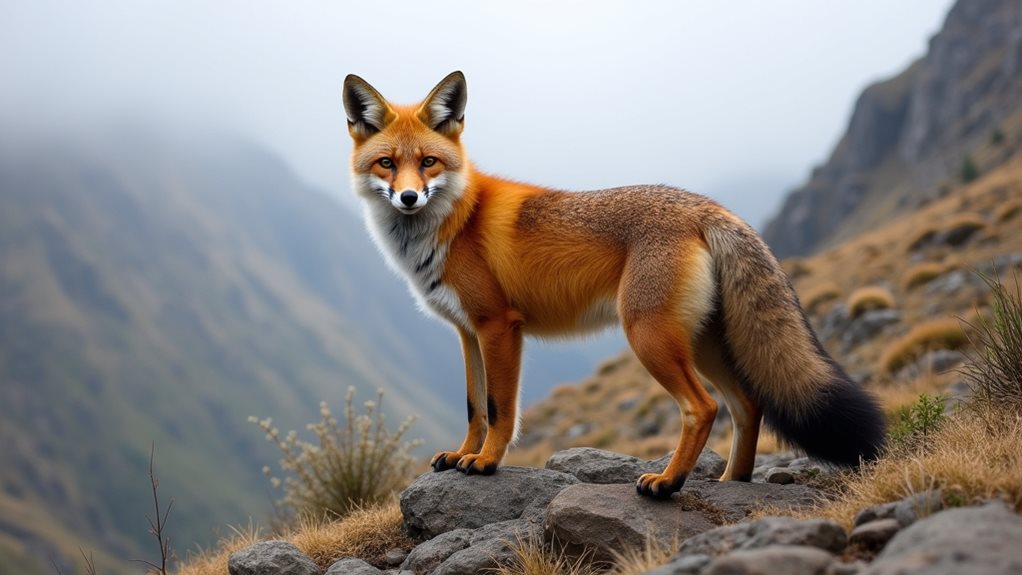
You’ll notice the Culpeo Fox stands out with its reddish-gray fur, distinctive black-tipped tail, and impressive size—reaching up to 33 inches long.
This resilient fox makes its home across South America’s diverse terrains, from the rugged Andes Mountains to the coastal regions of Chile and Argentina.
You’ll find them thriving at elevations up to 15,000 feet, adapting to various habitats including grasslands, shrublands, and even desert edges.
Physical Traits
Known for their impressive size, Culpeo foxes stand as South America’s second-largest canid species, dwarfed only by the maned wolf.
These magnificent creatures typically weigh between 11-20 pounds and measure about 24-30 inches in length, not including their bushy tails. Their fox coloration patterns feature a grizzled gray-brown coat with reddish highlights on their ears, neck, and legs, making them quite striking in their natural environment.
The fox fur texture varies seasonally, with:
- Dense, thick undercoat during colder months
- Lighter, more flexible fur in warmer seasons
- Coarser guard hairs that provide protection from the elements
You’ll notice their distinctive black-tipped tail and darker stripe running down their back—adaptations that help them blend perfectly into the diverse Andean terrains they call home.
Habitat and Range
While their physical adaptations help these foxes survive in diverse conditions, the Culpeo fox’s habitat spans an impressive range across South America.
You’ll find these resourceful creatures making their homes in the Andean regions of Peru, Bolivia, Argentina, Chile, and parts of Ecuador and Colombia. They’re incredibly adaptable, thriving in grasslands, shrublands, and even high-altitude mountain environments up to 4,800 meters above sea level! Additionally, habitat conservation is essential as human development encroaches on their natural territories.
These foxes play an important role in ecosystem impact, helping to control rodent populations and maintain the delicate balance of their environments.
When you’re hiking through South America’s diverse terrains, keep an eye out for these beautiful creatures—they’re masters at adapting to their surroundings, whether it’s a desert plateau or a mountain forest.
Sechuran Fox (Lycalopex Sechurae)
The Sechuran fox, one of South America’s most elusive canids, roams the coastal regions of Peru and Ecuador with remarkable adaptability.
You’ll find these clever creatures thriving in their Sechuran habitat of dry forests, deserts, and beaches where few other predators survive.
Their Sechuran diet reflects their resourcefulness as true omnivores. They’ll eat whatever the harsh environment offers:
- Fruits and berries during wet seasons
- Insects and small rodents they dig up from the sand
- Crabs and marine leftovers along the coastline
Despite weighing just 9-12 pounds, these foxes have mastered desert living.
Their large ears help regulate body temperature, while their sandy-colored coats provide perfect camouflage.
You’d barely notice one watching you from behind scrubby vegetation as it waits for nightfall!
Pampas Fox (Lycalopex Gymnocercus)
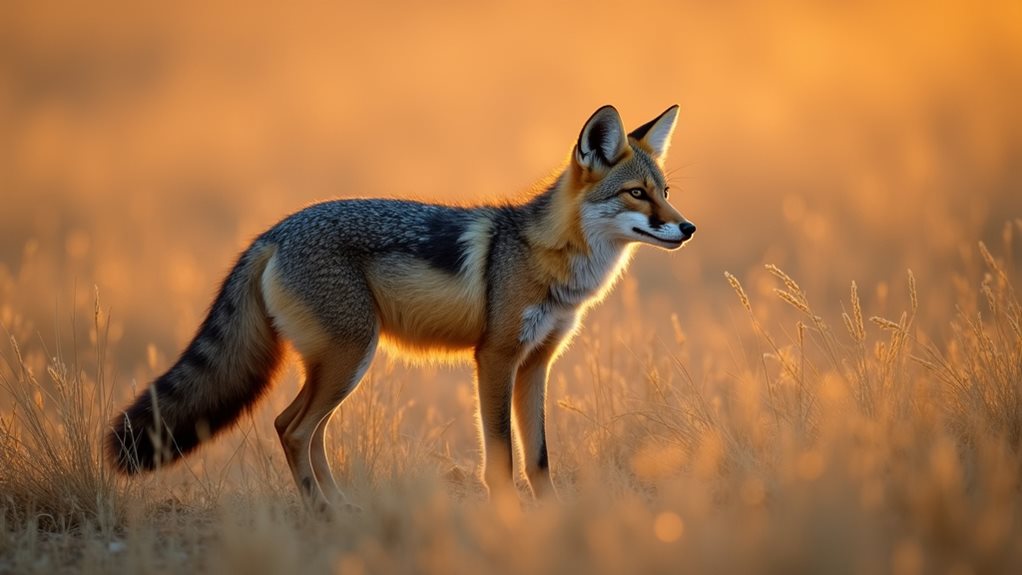
Moving from the coastal deserts to the grassy lowlands of South America, you’ll encounter the charismatic Pampas fox in its namesake habitat.
These adaptable canids thrive in the extensive pampas habitat of Argentina, Uruguay, Paraguay, and southern Brazil, where open grasslands provide perfect hunting grounds.
Unlike their desert-dwelling cousins, Pampas foxes enjoy a more varied pampas diet. They’ll happily munch on rodents, rabbits, birds, and insects while supplementing with fruits and berries when available.
You might spot them foraging at dawn or dusk with their distinctive grayish-brown coat and bushy tail.
What makes these foxes special is their resilience—they’ve managed to adapt to agricultural development that’s transformed much of their native grasslands.
They’re the ultimate survivors in a changing environment!
Hoary Fox (Lycalopex Vetulus)
Deep within Brazil’s cerrado savanna, you’ll find the diminutive hoary fox thriving in an ecosystem many larger predators avoid. This small canid, weighing just 3-4 kg, has developed remarkable hoary fox adaptations for its grassland lifestyle. Its grayish-silver coat (where it gets the name “hoary”) provides perfect camouflage among the dry vegetation.
The hoary fox habitat consists primarily of open grasslands where they’ve carved out a specialized niche:
Specialized survivors of Brazil’s open grasslands, hoary foxes thrive where few predators dare to venture.
- They’re primarily insectivorous, feasting on termites and beetles unlike most fox species.
- They’ve developed smaller teeth specialized for crushing insect exoskeletons.
- They create complex burrow systems to escape the savanna’s extreme temperatures.
You’ll rarely spot these shy creatures since they’re nocturnal and typically avoid human settlements. Their population faces pressure from habitat loss as agriculture expands across their range.
Silver Fox (Vulpes Vulpes Melanotic)
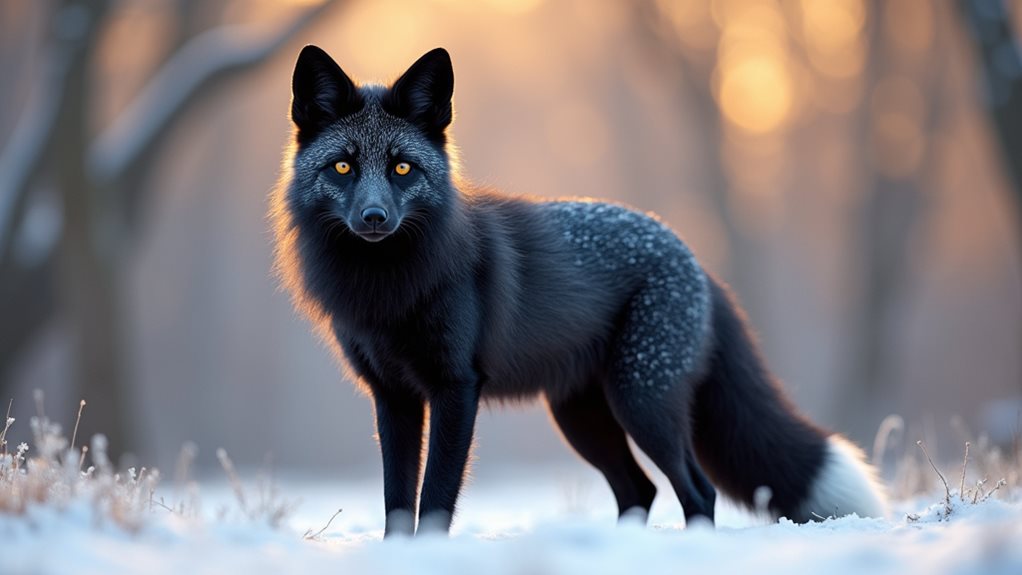
Stunning melanistic variants of the red fox, silver foxes captivate with their striking black fur tipped with silver-white guard hairs. You’ll find these gorgeous creatures aren’t actually a separate species but a color variant occurring in about 10% of red fox populations.
Silver fox behavior mirrors that of standard red foxes—they’re intelligent, adaptable, and surprisingly playful. You might spot them performing their famous “mousing leap” as they pounce on prey hidden beneath snow.
These clever canids thrive in diverse silver fox habitats, from forests and grasslands to mountains and even suburban areas.
While naturally occurring in the wild, silver foxes gained fame through fur farming and the remarkable Russian domestication experiment, where scientists selectively bred them for friendliness, creating foxes that behave remarkably like dogs!
Final Thoughts
You’ve traveled through the fascinating world of foxes, from the fiery red coats darting through forests to the pale Arctic hunters blending with snow. Whether it’s the tiny Fennec’s massive ears catching desert sounds or the Swift Fox racing across plains like a golden blur, these creatures captivate with their diversity. Next time you’re outdoors, you might glimpse one of these clever canids vanishing into the shadows, a reminder of nature’s remarkable artistry.